
This is part of an occasional series looking at aspects of Colorado’s faltering economy.
Colorado Springs cut more than 30 jobs. Boulder County dropped nearly 100 positions, and the city of Denver had to hack away at its budget, including laying off 171 employees.
While some Front Range population centers are experiencing those kinds of budget pains, not everyone approached this year's budget with a scalpel. While some communities are pulling back and cutting jobs, in other areas, budgets are steady or even growing slightly. Still, local leaders across the state acknowledge that 2026 may mark a change from the super-charged growth Colorado's experienced over the past decade.
Mapping a trend in city and county budgets is difficult, given the unique dynamics of local governments. The only thing most of Colorado has in common is economic uncertainty.
Rifle, on the Western Slope, is the largest municipality in Garfield County, and its officials said sales taxes, their primary source of revenue, continue to be solid. The projected budget growth for next year is 3 percent.
“Our City Market and our Walmart are big sales tax generators. Any time Silt gets a new resident or Parachute, then we end up with some more shoppers. So I think that provides some stability to Rifle,” said City Manager Patrick Waller. This fall, Rifle was able to increase the pay for all city employees and give the police department a significant salary increase.
He said Rifle has become a bit of a regional hub in part due to high housing costs in the Roaring Fork Valley that extends from Glenwood Springs to Aspen, which has pushed development to Rifle, where houses have historically been more affordable. Waller described it as a “young, active, dynamic community.” The median age is 32.
“We have space, we have water.”
Western Slope’s modest growth
An hour west of Rifle in Grand Junction, city officials are also projecting some growth, a 3 percent increase in sales tax revenue for the next year. It’s modest compared to some of the sales tax returns in the past five years, but more realistic, said City Manager Mike Bennett.
“Those types of years just in history don't last forever,” Bennett said, when sales taxes were booming amid post-pandemic spending. He said the latest projections suggest a slowdown.

While Grand Junction leaders say the money isn’t flowing quite the way it did, they’re not having flashbacks to post-2008 recession budgets, and the city is trying to be conservative when it comes to spending.
Grand Junction froze or eliminated a handful of positions and increased spending in other areas, including public safety. But overall, the city reduced operating expenses by about 10 percent, Bennett said.
Concerns about the labor market
The relatively healthy but slowing sales tax growth is a trend economist Nathan Perry is seeing throughout western Colorado. He said spending remains steady, but in some cases, consumers are buying cheaper items.
“So the high-end earners are spending normal and keeping consumption afloat, but the low-end consumers are the ones trading down and slowing down their spending,” said Perry, an economics professor at Colorado Mesa University.
He said there are also concerns across Colorado about the labor market, an area he’s watching closely.
“Hiring is low. The quit rate is really low, which means the people are afraid to leave their job. They know they can't get another job, and then layoffs are starting to accelerate.”
He described it as a frozen labor market and said if someone has a job, they’re fine, they’re not going to get laid off, but if they lose their job, it's very hard to find another job. He said for those who are unemployed, it may feel like a silent recession, a struggle even though the economic metrics look OK.
“I think that things are definitely slowing down. I think that the labor market is definitely grinding to a halt, but I think we need to see a big dip in growth and a big increase in unemployment to really call a recession.”
He said he’s been having the “is the country heading into a recession?” discussion for months.
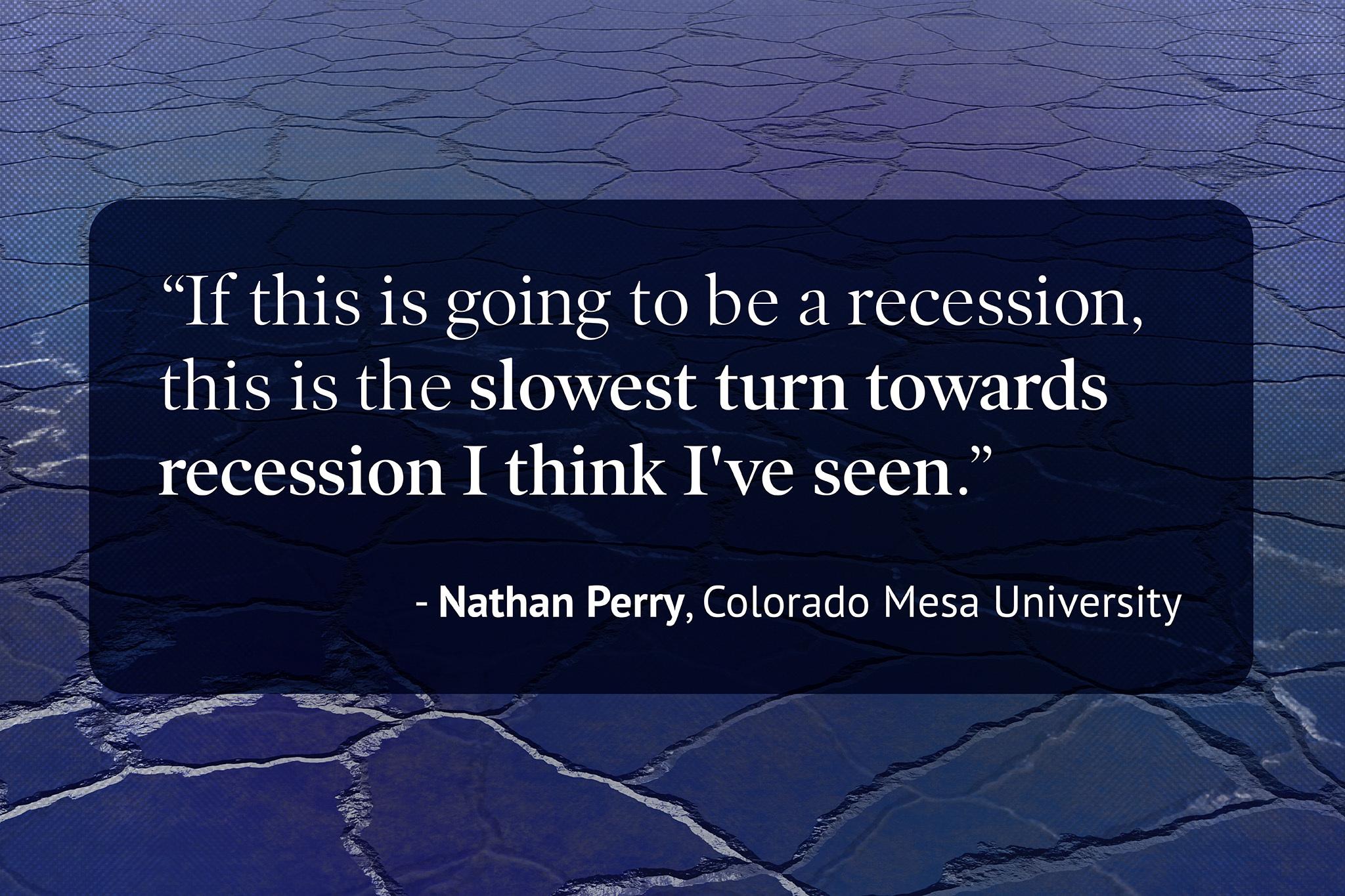
“If this is going to be a recession, this is the slowest turn towards recession I think I've seen.”
Some areas more cautious than others
The town of Mountain Village near Telluride, however, is expecting a drop in sales tax returns — by about 4 percent — as opposed to just slowed growth. That’s because of their dependence on the lodging sector, which they anticipate to slow down compared to recent years. That expectation is based on travel industry projections and a cautious approach from the town council, Finance Director Lizbeth Lemley said.
“We don't ever want to be caught off guard in those instances, but it does look like just in the trending marketing data that we're getting, that the lodging sector alone will be behind about 4 percent. And then we have some differences in our restaurant and bars that we're projecting kind of a slowdown there,” Lemley said.
Those changes won’t lead to staff reductions at this point, Lemley said.
Mountain Village Town Manager Paul Wisor said resort communities do have some insulation from drops in tourism that didn’t exist in the past, making a decline in tax revenue less of a shock to the system. Previously, resort communities needed to fatten up on ski season revenues to make it through summer.
“When there are these significant drops in visitation from true out-of-state visitors, that certainly impacts our winter numbers,” Wisor said. “But we now do have this entire summer season where we do draw more people from inside the state, and I think blunts the impact.”
Challenges vary widely
Counties are facing their own unique challenges. Counties rely on property taxes, and are a subdivision of the state and also administer key programs.
“Plowing or road maintenance and really probably some that people don't know, like child welfare and different human services programs, administering SNAP and TANF and other really key safety net programs that are critical for the health, safety and welfare of our residents,” said Kelly Flenniken, the director of Colorado Counties.

Those safety net human programs are expensive to run, and even more so due to added costs trickling down from federal changes that have shifted more costs to states. Flenniken said counties are sharpening their pencils to try to figure out how they can effectively deliver services without significant cuts.
“Trying to wade through unfunded mandates. I think a lot of counties are really focused on that, and how they will be able to keep a balanced budget, keep their workforce, all of those really important elements. It's tough, and counties don't have a lot of levers to pull to change or add to their revenues.”
For Larimer County in northern Colorado, keeping a balanced budget means not hiring more county employees and cutting some services. Larimer County Commissioner Kristin Stephens said the county is no longer participating in two programs that aim to help people afford to stay in a home or apartment. The county also reduced funding for wildfire mitigation grants that help people protect their homes from the risks of wildfires, to do things like clear trees and vegetation.
“So they're not luxury items. They're items that are really important to our community, but they're also, we're not required to provide those programs. And so we're finding that we have to eliminate programs like that.”
As she looks to the future, Stephens said the county will actually have to hire more staff to implement things like Medicaid work requirements and increased work requirements for SNAP, which provides food benefits to low-income families.
“So that's a pressure that we're anticipating, and I think there's just a lot of uncertainty.”
Another state shortfall looms
Then there’s the state budget shortfall, which was close to $1 billion and is expected to be $800 million short in the upcoming fiscal year.
“Obviously, Colorado has also decreased their budget.” Stephens pointed to a recent $200 million transportation cut.
“We already struggle with transportation dollars, so having fewer transportation dollars means projects that keep people safe on the roads, that help with congestion on our roads, some of those projects have gone away.”
Flenniken said the federal and state budget constraints are putting counties in a hard, precarious and uncomfortable position as they try to build and forecast their budgets.
The state may have a clearer picture of local fiscal conditions in the next few months, when the Colorado Municipal League releases a survey of cities and towns.
“But I can tell you just talking to members around the state, it really is a mixed bag,” said Kevin Bommer, the Executive Director of the Colorado Municipal League. “I would say at best, most municipalities are flat, projecting flat for next year rather than seeing massive reductions.”

Colorado’s economy is flashing warning signs. Job growth has slowed to a trickle. Layoffs are inching up. The housing market is in a slump. Both the state and its biggest population center are struggling to plug massive budget holes. On top of all that, the longest government shutdown in history was weighing on the economy.
The big question, though, is whether all the bleak data points to something more serious: recession. And the answer is complicated.
Colorado Public Radio takes a look at what those warning signs might mean through the new series Silent Recession. Read more stories in the series here.