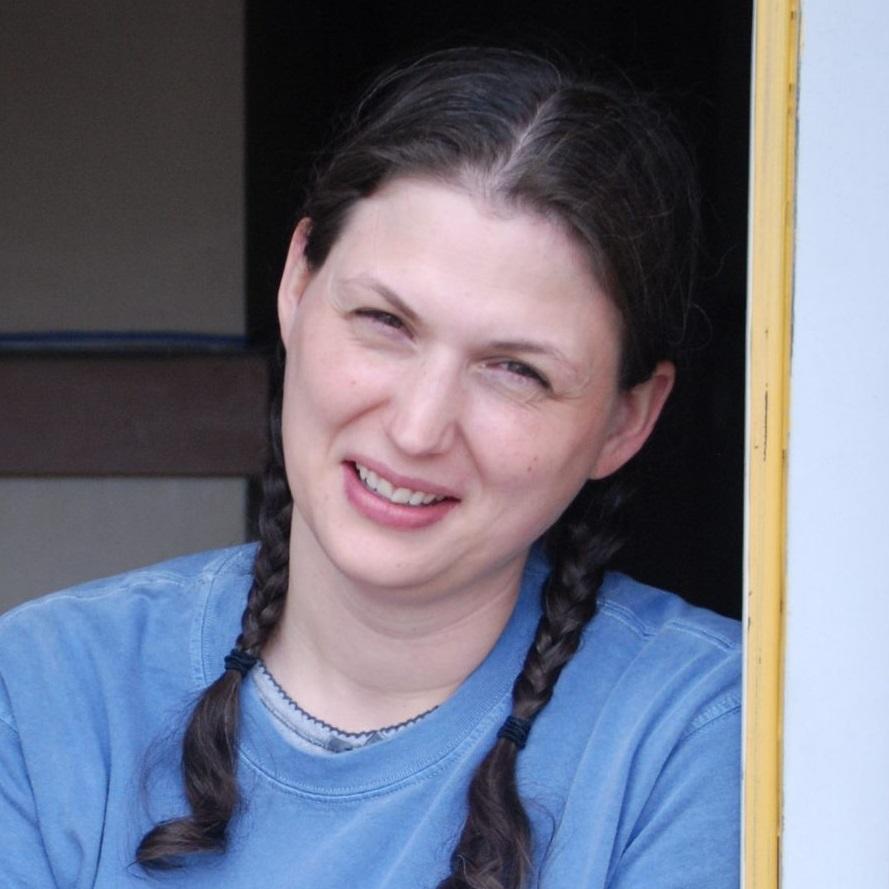
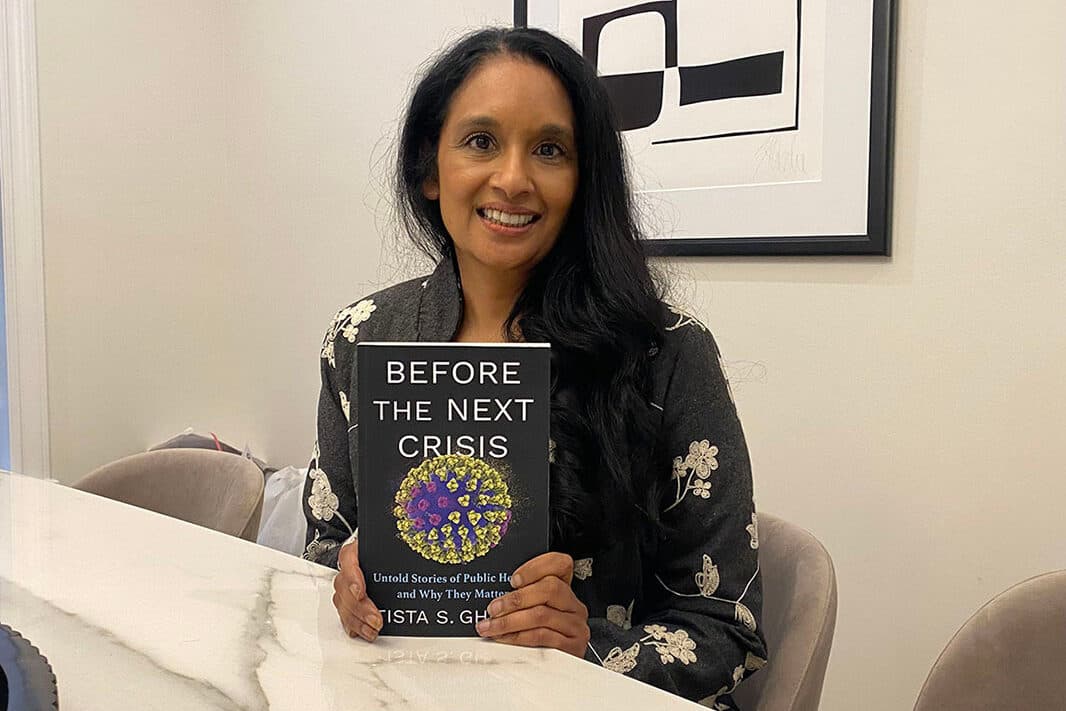
She was a top public health official in Colorado. Then, after leaving the public sector, Dr. Tista Ghosh advised Fortune 500 companies during the pandemic, helping them keep workers safe. Now, after writing a book about lessons learned during the pandemic, she’s finding an audience on social media, getting millions of views and thousands of followers.
“I am trying to live what I'm preaching to,” Ghosh said in a recent interview. Her book called “Before the Next Crisis: Untold Stories of Public Health and Why They Matter,” was published in August.
Those stories matter, Ghosh said, because she thinks public health can do better. After working with companies during the COVID-19 crisis, she started gathering stories from rural and urban folks in red and blue states.
“I learned that local context matters,” said Ghosh, who served as Colorado's chief medical officer from 2015 to 2019.
A construction worker in a warm-weather southern state didn't see a lot of COVID-19 cases early on. So, he and those around him didn't take precautions seriously, she said. “And then when it finally hit their communities, they weren't so ready to believe and he ended up losing people, colleagues, family members as a result of that ... They died.”
Early on, in 2020, the World Health Organization posted on social media that COVID was not airborne. That was incorrect. Ghosh said that the post had an impact on a Colorado gym owner.
“His business suffered as a result of not being able to hold outdoor-type classes until much later when we realized, 'Oh my gosh, COVID is airborne,'” said Ghosh.
Ghosh said there's now a lot to be learned.
“I realized as a public health person that we got a lot of the messages wrong and we created a lot of confusion,” she said. “And that planted the seeds for a lot of the distrust and disinformation that we're seeing today.”
One thing she'd like to see now is more health experts engaged on social media to push back against disinformation. She started to do that herself.
She's now posting videos with health information, along with links to scientific studies
You can find her content on social media, like a video on heart health. "Let's chat today about some simple health hacks that can help your heart,” she said in a video.
To dive into the social media world, she got plenty of help from her college-age son and her daughter, Naiya, who is in high school. Their dog, Gnarly, a shaggy doodle, even appears in some videos.
Naiya gave advice about creating content for social media, editing and what she thought worked and what didn’t.
“A lot of teenagers are, like, on their phones a lot and I just see people looking on Instagram. I like to watch videos, and I think they're way more interesting than books to a lot of people,” said Naiya. “They're more watched because books, not everyone reads all the time, but videos are watched and rewatched and rewatched and just very popular in my generation.”
She seems to be reaching a new audience. Dr. Tista Ghosh, or HealthHacker MD, now has 29,000 Instagram followers.
The following is from an interview Dr. Tista Ghosh did with CPR Health Reporter John Daley. It was edited for brevity and clarity.
Daley: Tell me why you wrote this book.
Ghosh: I wrote this book because, during the pandemic, I consulted with Fortune 500 companies across the U.S. and helped keep essential workers safe during the pandemic. And I started gathering stories from people in rural and urban areas, red and blue states, and I realized that a lot of these stories weren't being told. They showed an important lesson that we needed to learn from.
Daley: Can you give me a couple of specific stories and what you learned from those?
Ghosh: I learned that local context matters. So, for example, I interviewed a construction worker who worked in the South, and they didn't get a lot of cases till much later in the pandemic because they were in a warm-weather state. And I learned that they didn't take any of the precautions seriously because they didn't see much virus in their communities. And then when it finally hit their communities, they weren't so ready to believe and he ended up losing people, colleagues, family members as a result of that.
Daley: So they died.
Ghosh: They died. And I also remember a story of a rural Wisconsin physician who was telling me that they didn't have any cases till October of 2020 in their community. But if you recall, the entire country basically shut down in March of 2020. So you can imagine the skepticism that would exist in her community, given the fact that they didn't really have any cases until six months later.
Daley: You talked to some business owners as well.
Ghosh: One of the stories I gathered was from a Colorado gym owner who would have loved to keep his gym running with outdoor classes if possible. But unfortunately, we were told that airborne transmission, which is lowered outside, wasn't how COVID was spread. We were told it was droplet spread. And in fact, the World Health Organization tweeted “#COVID is not airborne.” So as a result, all our policies focused on staying indoors and nobody going outside, and he had to close his doors. His business suffered as a result of not being able to hold outdoor type classes until much later, when we realized, “Oh my gosh, COVID is airborne.”
Daley: What were the takeaway lessons you learned from your experience, both advising big companies and writing this book?
Ghosh: First of all, I would say it was a humbling experience to talk to people from all over the country because I realized as a public health person that we got a lot of the messages wrong and we created a lot of confusion. And that planted the seeds for a lot of the distrust and disinformation that we're seeing today in America. That said, I do think it's fixable. I think we need to recognize the errors, and that's why I encourage people to read this book and really learn from it and see the importance of learning from our past mistakes, but also super important to advocate for public health. For health in general, I guess I would say I would like people to look more critically at the health information that they're getting online and ask themselves, would they take their car if it broke down to a hairdresser, because the answer is probably no.
They'd rather go to a car mechanic, and yet they would put their body and their health and the health of their family in the hands of some random wellness influencer who's probably a shoe salesman, again, think critically. And just because you were angry about the pandemic or there was confusion related to the pandemic doesn't mean that that random wellness influencer knows what they're doing any more than they did before the pandemic. So thinking critically about who's talking to you and what they're saying, that's really important. Thinking critically about what's happening in society and where you're getting your information super important,
Daley: Especially now, before the next crisis, what are some of the risks and how can society head them off?
Ghosh: Unfortunately, the health threats that we saw during the pandemic are not one-and-done. We are gonna get more health threats with climate change. There's gonna be more viruses, um, more mutations, people getting into different locations that they weren't before. Lots of opportunity for threats, bio weapons, that's still a threat and will continue to be. And then of course there's climate change itself and natural disasters and all the threats that that brings to people's health and safety. So we need to get our public health system, our healthcare system and our information system fixed so that we can actually handle the next crisis. And we need to do it now before it hits.
Daley: So there are a lot of threats and misinformation. What can be done about that?
Ghosh: I think I would also say I'd encourage physicians and public health experts to be more directly on channels like social media and other places where the community is, meet people where they are. Don't just hide in your ivory towers because, without your voice, the random people who are making health information available with absolutely no expertise are gonna have the vast majority of the hearts and minds of the country. And we need your voices out there.

Daley: Your career path has been pretty interesting, where you are Colorado's chief medical officer, now working in the private sector and trying to spread the word about being smarter with public health efforts and dollars. Where are you going next with this?
Ghosh: Interesting that you say that because my children challenged me when they read this. They were like, "Mom, I/we get that you're passionate about public health being dismantled and the concerns over the next health threat, but you wrote a book and most people are not going to — they don't read books, they're on Instagram or TikTok. So you're telling doctors and public health people to get out there and you're not getting out there." And they challenged me. So I actually started an Instagram channel and have been sharing health messages. I'm not selling anything, I'm just sharing actual science, but in a fun way. They're my social media consultants. My children are my social media consultants. I am trying to live what I'm preaching to, it's a start, and I encourage others to do the same.
Daley: What channels are you on now?
Ghosh: I'm mostly on Instagram right now. I haven't done TikTok because they kept saying it was going to go away and then not go away, so I didn't bother, but maybe that's where I'll go next. On Instagram, I have about 29,000 followers now, which I am shocked by.
Daley: That's pretty good.
Ghosh: Yeah, I have teenagers telling me what to, how to, to make it interesting 'cause I, I think I wouldn't have done it that way. But that's helped me get really short health-related messages out to the public in less than 60 seconds in fun ways. My dog Gnarly is often featured. But, you know, I think for me it's a stretch. It's really pushed me probably much harder than writing a book for me. But it’s something that I think a lot of physicians, public health experts need to do because we're, we're not, we're just talking to each other. We're not talking to people where they are, and instead, those people are getting, you know, their health information from some random guy who has absolutely no credentials at all.
Daley: This is an issue for all kinds of communicators, journalists, for sure.
Ghosh: For your content, for sure. If it can be condensed, they need that really quick soundbite and it really challenges you to distill your information to the bottom line. But that's where people are and that's where they're getting their information. So we should be out there.
Daley: So you're giving them science-based information?
Ghosh: Yes. And the goal is to not only build my own credibility with them, but also for them to be more critical to say, “Hmm, she actually posts the studies that do. The other people I listen to or watch, do they ever actually cite anything?” The answer's probably no, because I haven't really seen that. But you know, I'm trying to get people to maybe think a little bit more critically.