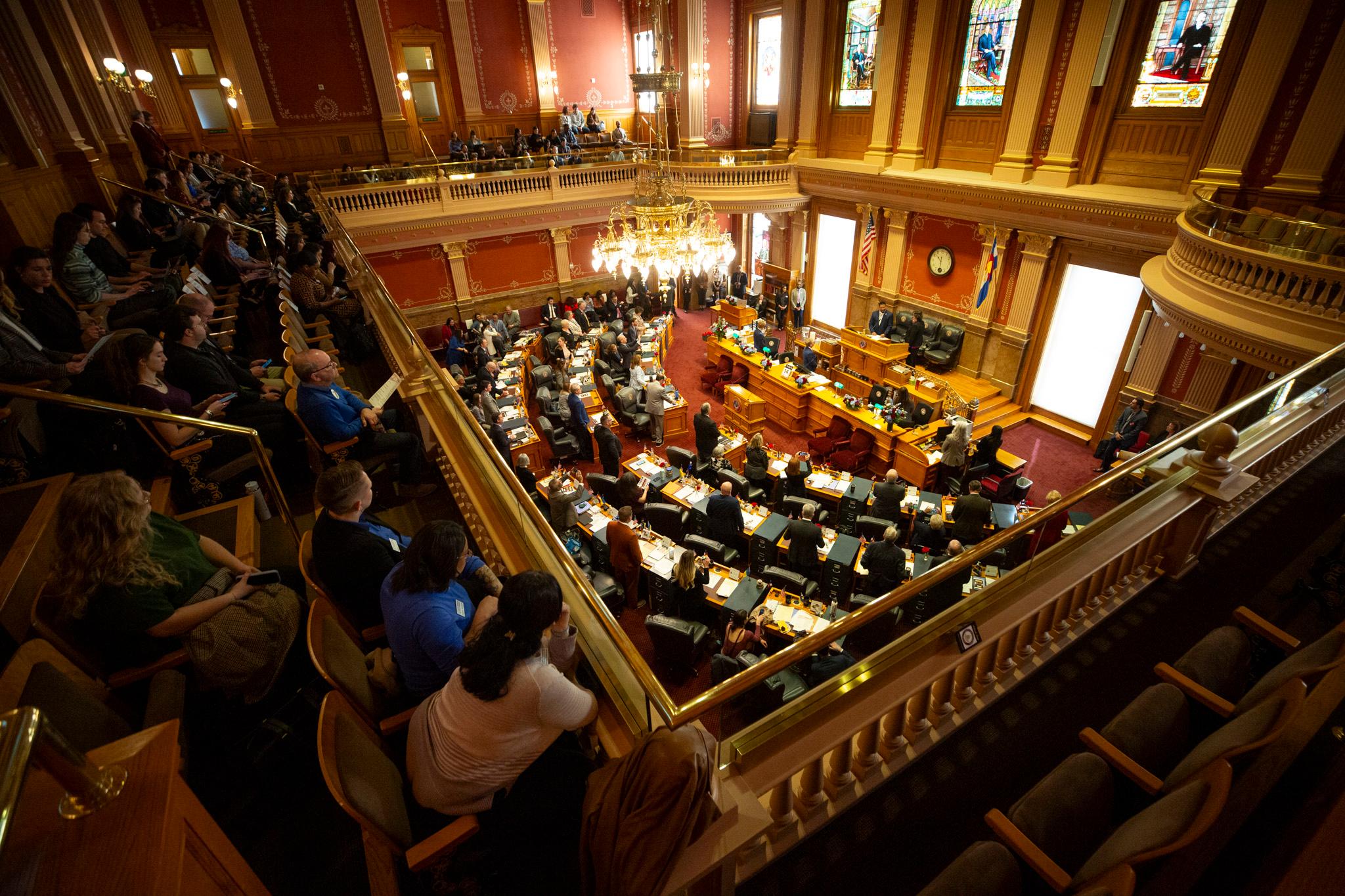
The Trump administration continues to take aim at Colorado, and state leaders are making a push this legislative session to try to insulate the blue state.
“I haven't seen this level of intrusion from the federal government into state affairs like we're having now,” said Democratic Sen. Marc Snyder, of Colorado Springs. “ So we are looking proactively at what we can do.”
Democrats hold a wide majority in the legislature and are moving forward with a slate of bills in response to the Trump administration, although their ability to counter federal actions will inevitably be limited by cost concerns in a year when the state is dealing with a roughly $850 million state budget shortfall.
“Regardless of what's going on with the federal administration, we are trying to find things we can do with limited resources to make lives for Coloradans better,” said Democratic Senate President James Coleman of Denver. “It's looking at all the angles we can without having any policies that cost the state money.”
Much of the legal pushback against the Trump administration in Colorado has been in the courts. Attorney General Phil Weiser’s office is part of roughly 50 lawsuits alleging federal actions are illegal or unconstitutional, from federal funding cuts that target Colorado, sharing information with immigration authorities, to efforts to shut down the National Center for Atmospheric Research in Boulder, and plans to move Space Command from Colorado Springs to Alabama.
Meanwhile, President Donald Trump has made it clear during his second term in office that he doesn’t like a lot of things the blue state of Colorado is doing, and the White House has said he has broad authority to fund his own priorities.
“The president’s administration has been clear on what their values are,” said Democratic House Assistant Majority Leader Jennifer Bacon. “We feel like we should be clear on what ours are.
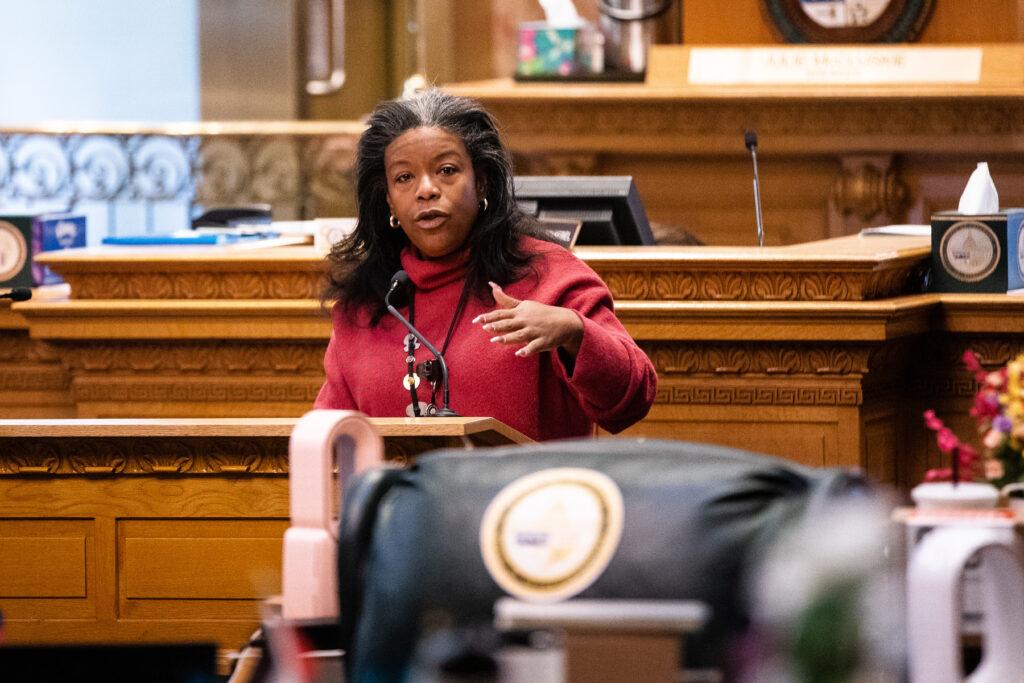
Democratic Rep. Kyle Brown of Louisville serves on the legislature’s Joint Budget Committee and said the state will try to soften the blow from the federal government, which he no longer views as a willing partner.
“If anything, our federal government has unfairly targeted Colorado for cuts…I am disappointed that our president doesn't seem to think that he governs the entire country or that he is the president for the entire country. People in Colorado voted for him, too.”
So far, Republicans are urging caution and worry Democrats will use allegations of federal overreach and retaliation as a justification to pass laws that aren’t good for the state. Others say Trump’s actions should be expected in a blue state.
Republican Sen. Larry Liston of Colorado Springs said it’s really a federal issue. He blames Colorado’s congressional delegation for not trying to work with the Trump administration, saying they are “hell-bent on voting against everything that Trump brings up, there are consequences to that. Not that they have to go hand in hand, but our congressional delegation has done everything they can to, no matter what Trump has suggested, they've been against it.”
Liston thinks it’s something the State Legislature should stay out of.
“I think whatever state lawmakers are trying to do to push back, I don't think that we need to be wasting our time on that personally,” he said. “It's just my opinion.”
Here are a few of the bills Democrats are trying to pass in response to the federal Trump administration.
Immigrations and Customs Enforcement
Colorado continues to try to limit what information the state can share with ICE. A Democratic bill that has not yet been introduced would expand an existing law that would prevent state officials from sharing personal identifying information with immigration authorities unless there is a criminal investigation. The new proposal would expand that ban to include local agencies, not just individual officials.
Another bill seeks to regulate how the state shares information from flock cameras. The cameras read license plates and help law enforcement track down vehicles in real time by tracking a vehicle’s movements. But backers of the bill want to set limits on how long the data can be stored and how it’s used. It would require law enforcement to get a warrant for the data in many cases, and also restrict how long the state could store it to four days.
“This is really about when a local government deploys these cameras, what can they do with the data that they collect and who can have access to it and when?” said Democratic Sen. Judy Amabile of Boulder, the main sponsor.
Amabile said the policy is in direct response to the Trump administration.
“We don't want local law enforcement to be inadvertently sharing this data with ICE … The second thing is people coming to our state for abortion care, and we have a shield law here, but we don't want sharing with other states who maybe have a different set of laws around that. And then the third thing is that we generally do not want to have mass surveillance of the citizens in the state of Colorado.”

The proposal is already facing pushback. House Minority Leader Jarvis Caldwell said he doesn’t support mass surveillance, but doesn’t believe that’s what’s happening. He thinks the bill would make day-to-day life harder for law enforcement on crucial investigations and public safety.
“I think we're going to see some bills in the name of civil liberties and Fourth Amendment rights that are actually really anti-law enforcement bills, but it'll be used, it'll be passed in the name and justification that this is actually against ICE.”
Another bill is aimed at holding federal immigration agents accountable for how they operate in Colorado by creating an avenue for people to sue immigration officers in state court for violating their constitutional rights.
“The federal government has to follow the law too,” said Democratic Sen. Mike Weissman, who sponsored that bill as well as a resolution calling on federal agents to uphold “humane enforcement practices.”
“Contrary to some of what you hear coming out of D.C., we do not run this country by fiat,” he said. “The President is not all-powerful. There is no absolute immunity for federal immigration agents.”
Some of the policies this session would build on proposals lawmakers passed last year.
Health and vaccine policy
A bill to expand vaccine access in Colorado is the Democratic state lawmakers’ answer to the Trump administration’s changes to immunization policy.
Colorado has long linked state vaccine policy to federal recommendations. But state Democrats say that approach is no longer appropriate. Last month, the Centers for Disease Control and Prevention reduced the number of recommended routine childhood vaccines. Senate Bill 32 would have Colorado adopt the more comprehensive vaccine guidance from the American Academy of Pediatrics.
“This bill is insulating our state from the dysfunction coming out of Washington,” said Democratic Sen. Kyle Mullica, a registered nurse, who sponsored the bill. “In this state, we’re going to rely on science.”
At least 20 other states are also decoupling their vaccine policy from federal recommendations.
“When federal guidance becomes unstable, providers are left unsure which standards to follow, pharmacies question their authority, insurers hesitate on coverage and families experience confusion and delays in care,” said Susan Lontine, executive director of Immunize Colorado and a former state Democratic representative.
Another set of proposals strengthens worker protections at the state level that have been or may be attacked at the federal level. One bill would enshrine into state law any federal safety requirements that are repealed, revoked or made less stringent by the Trump Administration.
Another bill still in the works would protect workers dealing with extreme weather conditions and require employers to give all workers access to water, shade and rest during extreme heat conditions. Similar measures would protect workers facing extreme cold.
The Biden-era Occupational Safety and Health Administration (OSHA) originally developed those standards, but the Trump administration took over before they could be implemented and they remain in limbo.
“We have seen workers die across the nation, from delivery drivers to airport workers. We want workers to be able to come home after their shift,” said Democratic State Rep. Elizabeth Velasco of Glenwood Springs, who is planning to sponsor the measure later this month
Last year, the House defeated a similar proposal to protect agricultural workers from extreme heat.
Protecting local institutions
A proposal aimed at shielding Colorado nonprofits from politically motivated attacks by the Trump administration is so far one of the few policies that has Republican support. It cleared its first Senate committee unanimously.
That bill is a response to the Trump administration's threats to revoke the tax-exempt status of nonprofits it doesn’t agree with.
It is not clear that the tax status of any Colorado nonprofit has yet been targeted by the Trump administration, but Democratic Sen. William Lindstedt of Broomfield, who sponsored the bill, called it a common-sense preemptive measure.
“Broadly, when the administration makes threats against nonprofits, anyone providing services in our state has reason to worry,” Linstedt said, adding that organizations working in the environment, immigration and diversity, equity and inclusion, or DEI spaces appear particularly at risk.
It would explicitly and preemptively insulate this part of the Colorado tax code from the federal government’s, ensuring nonprofits to keep their state tax-exempt status even if they lose federal tax exemptions.
Republicans are backing the proposal. Senate Minority Leader Cleave Simpson said there was no controversy for him because it wouldn’t actually change how Colorado currently implements tax law, which has never explicitly been linked to Internal Revenue Service policy.
“I supported it largely because it was a do-nothing bill,” Simpson said. “The sponsors talked about the need and necessity to decouple from the federal government and the (federal tax-exempt) 501C3 designation, but there's nothing in current statute that couples us to 501C3.”
He minimized the measure as mere political signaling on the part of his Democratic colleagues but said he supported the impulse to protect the state’s charitable organizations.
Another proposal would create a pathway to pursue school-based discrimination cases in the state court system, ensuring Colorado students are covered by constitutional civil rights protections that have grown less certain in the Trump era.
“The president has tried to defund particular agencies that have been arbiters of civil rights, like the Office of Civil Rights in the US Department of Ed,” said Bacon, who sponsored the bill. “The purpose (of this bill) is to say harassment is still discrimination under state law.”
Yet another bill would reinstate at the state level housing accommodations for people with disabilities that until recently had been covered by federal anti-discrimination law.
Democratic lawmakers say they’re not done yet. Several more bills designed to respond to the excesses of the Trump administration are in the pipeline and will likely be introduced in the coming weeks and months. That’s what they were elected to do, according to Bacon.
“Our constituents are asking us every day what's happening and what are you doing, or why don't you do this? These are the things that we need to feel safe and protected,” she said.
Given the political imbalance in the statehouse, Republicans may not have much of a say about which of those bills pass. But Simpson says he’ll consider each proposal on its own merits, regardless of the motivating forces behind it.
“That's how I function, whether we're talking about immigration or whether we're talking about immunization or whether we're talking about charitable status,” he said. “If it's still reasonable policy or good policy, I'm supportive.”