
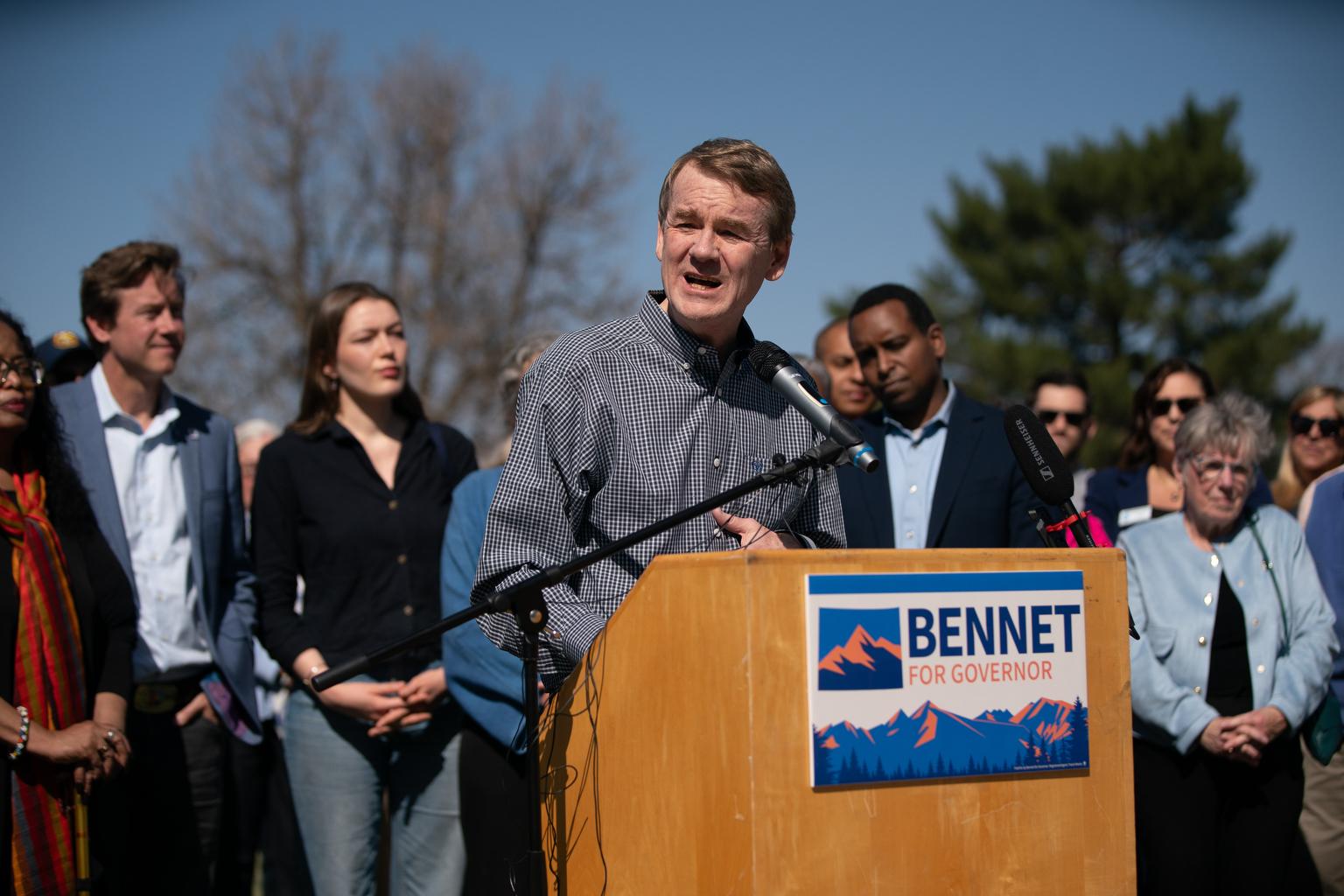
If Sen. Michael Bennet wins his campaign for Colorado governor, his administration would support a climate strategy that’s struggled to gain traction under Gov. Jared Polis: a statewide “cap-and-invest” program.
Bennet released the brief policy outline through his gubernatorial campaign on Monday. The platform calls for a market-based policy built around a declining cap on climate-warming emissions. Colorado already has established climate targets, which require the state to eliminate its contribution to global warming by 2050.
The state would then issue or sell a limited number of permits each year, allowing companies to release a certain amount of planet-warming pollution. Revenue generated in the process could help cut utility bills and support clean energy technology, priorities specifically cited in the platform published by the Bennet campaign.
“I believe Colorado can be a leader in building a future that protects our environment, makes life more affordable for our families and supports our businesses,” Bennet said in a new statement announcing the proposal. “To do that, we need to move beyond the status quo and embrace new, proven and innovative strategies.”
A potential shift in Colorado’s climate strategy
The platform hints at how Bennet could harness climate policy as one part of an affordability agenda, offering discounts on energy bills with revenue generated through a cap-and-invest program.
Along with other parts of the country, Colorado residents could soon face rapidly rising energy costs as AI data centers, all-electric buildings and electric vehicles contribute to skyrocketing electricity demand. The dynamic could lead utilities to rush to reinforce the electricity grid — and pass the costs along to households.
Meanwhile, Colorado power providers like Xcel Energy are already moving forward with a rapid transition to wind and solar. Those investments could improve air quality and insulate ratepayers from volatile fossil fuel markets, but they also set the stage for repeated rate hikes for residential customers over the next decade.
Bennet’s new climate plan also offers a sharp contrast with Gov. Polis, who has pushed back against a “cap-and-trade” or “cap-and-invest” strategy as governor. In 2021, for example, Polis issued an executive order claiming the approach could work on a federal or international scale, but insisted Colorado should focus on incentives, voluntary agreements and tailored regulations to cut emissions.
Since then, his administration has approved a limited carbon trading program to cut climate-warming emissions from the state’s biggest industrial polluters. Meanwhile, it’s attempted to shift other parts of Colorado’s economy away from fossil fuels with incentives, such as generous tax credits to cut the cost of EVs and all-electric home heating systems.
“They’ve tried to keep it at arm’s length,” said Pam Kiely, an associate vice president for the Environmental Defense Fund who’s pushed Colorado to enact a cap-and-invest policy. “We think that’s been a missed opportunity.”
Kiely said she’s glad Sen. Bennet has adopted a different view of the policy scheme. Her organization, however, hasn't endorsed any candidate in the Colorado governor’s race.
The official announcement included supportive quotes from Kiley as well as the owners of a solar-powered Pueblo steel mill and the business manager for IBEW Local 68, a union representing electrical workers in metro Denver.
It’s unclear if the broader business community supports the policy outline. Cynthia Eveleth-Havens, a spokesperson for the Colorado Chamber of Commerce, said her organization needed more time to review the proposal before offering an official comment.
An initial play for Colorado climate voters
Bennet faces Colorado Attorney General Phil Weiser in the upcoming Democratic primary for governor.
Weiser’s climate platform doesn’t specifically endorse cap-and invest, but calls to continue aggressive efforts to invest in low-carbon energy sources like wind, solar and geothermal.
In a written statement, Anna Huck, Weiser’s campaign manager, said Bennet’s plan leaves a lot of “open questions.” She also honed in on the senator’s support for nominees now leading President Trump’s efforts to roll back federal climate policies, such as Secretary of Energy Chris Wright, a former fossil fuel executive who insists climate change doesn't amount to a global crisis.
"Any plan to address our climate challenges does not justify his votes to confirm Trump cabinet picks like Doug Burgum, Chris Wright, Sean Duffy, and Brooke Rollins, who are now dismantling climate protections and threatening our public lands,” Huck said.
Washington and California are the only U.S. states with cap-and-invest policies covering their entire economies. New York is currently embroiled in a legal fight over whether to enact a similar law first approved in 2019.
The overall strategy has proven popular with voters in Washington. In 2024, the state’s residents overwhelmingly shot down a ballot initiative to scrap the climate policy by a 24-point margin.