
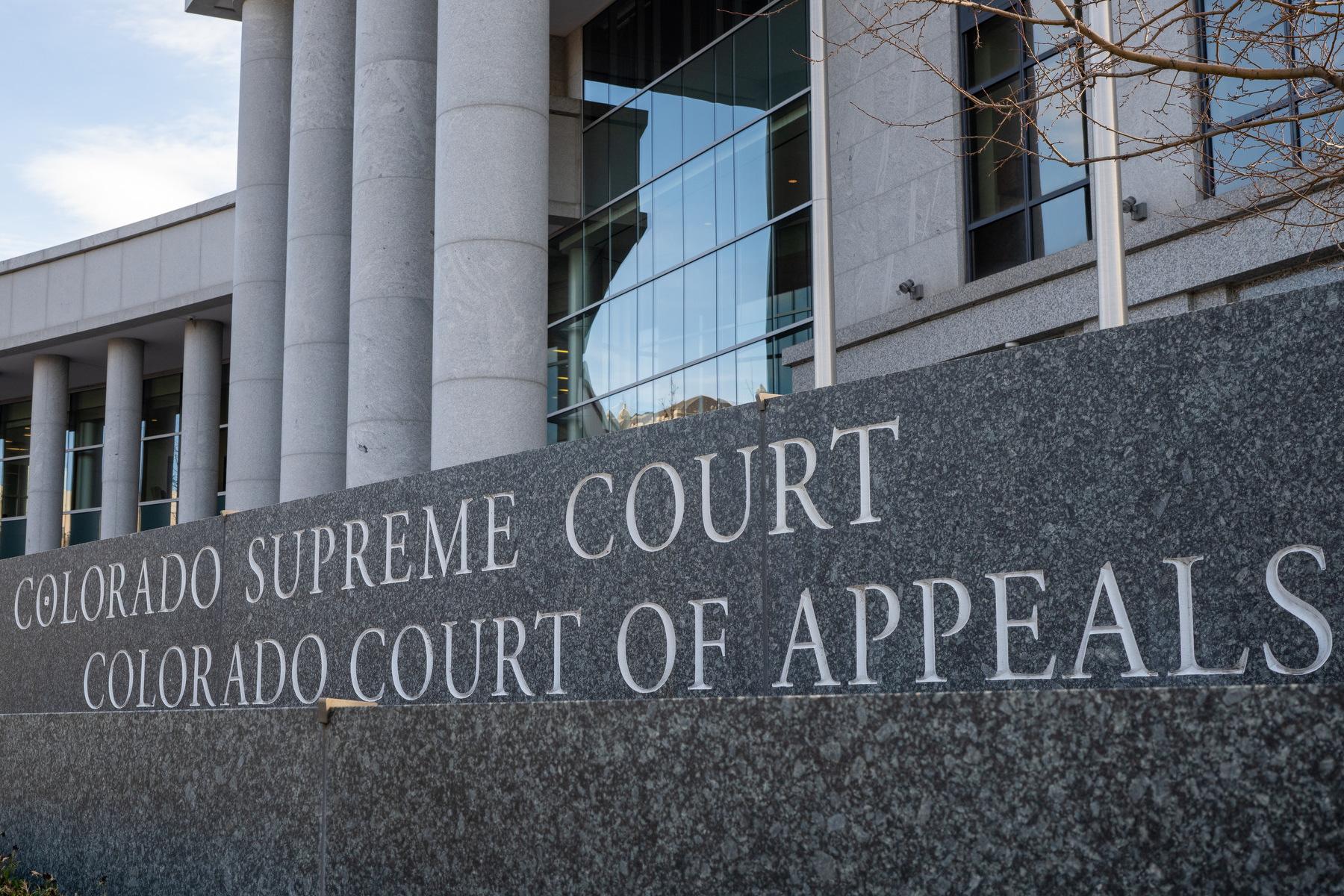
The outcome of two local municipal court cases could look very different after a recent Colorado Supreme Court ruling decided municipalities can’t give defendants sentences that are harsher than the state code for identical crimes.
The Supreme Court case originated from separate instances in Westminster and Aurora municipal courts, where defendants faced higher potential penalties in their local courts compared with the state code. The attorneys challenged the municipal court sentencing, and ultimately, both cases were argued before the Supreme Court in May.
The Colorado Municipal League, which filed a brief in the case, urged the Supreme Court to allow municipalities freedom over their sentencing laws, citing constitutional protections for communities.
“There’s a lot about the opinion that worries me,” said Kevin Bommer, the executive director of the Colorado Municipal League. “This cuts to the core of local authority, and in particular, home rule authority.”
Others involved in the case, like city public defenders and the Colorado ACLU, are taking it as a victory.
“It’s a great decision because it's bringing fairness to the people who are facing low-level misdemeanor charges in municipal courts,” said Colette Tvedt, the chief public defender for the city of Denver.
In one of the originating cases, Danielle Simons faced trespassing and a motor vehicle trespassing charge. For both, she was charged in violation of the Aurora City Code, which held higher potential penalties than if the case were in the county system. For her trespass charge, the difference between penalties was 354 days in jail and $2,350 in fines. The municipal maximum for time served on her vehicle trespassing charge was around three times more than the state penalty for the same crime, and more than double the fine.
“Jail time for anyone is life-changing. Ten days is an amount of time where you can lose your job, lose your housing, affect your kids. Ten versus 364 is absolutely a devastating difference,” said Ashley Cordero, Simons’ court-appointed attorney in Aurora Municipal Court.
The other case arose from a woman who was charged with theft in Westminster. She faced a maximum municipal fine nine times greater and jail time 36 times longer than state penalties.
Tvedt said long jail times have collateral consequences for her clients.
“There's so many areas that are impacted by sentences that are more than 30 days, which we've seen in municipal court on these low-level offenses,” she said. “If you got a sentence of 30 days or more, your social security benefits could be or would be suspended, SSDI, Medicaid, SNAP. You couldn’t pay your bills. You could lose your job.”
Contention between cities and the state
After Colorado passed reforms to state penalties for misdemeanor and petty offenses in 2021, many municipal courts held onto their harsher penalties. Tvedt said those discrepancies in sentencing maximums between municipal and state courts have been frustrating for public defenders.
But Bommer of the municipal league said that those distinctions are important, allowing municipal courts to address local crimes with penalties they deem most effective.
“Municipal courts and home rule municipalities especially, specifically prior to this decision, had been enabled to address crimes that were occurring, that were of significant local importance to the extent that they wanted to highlight them and to be able to address them more significantly,” Bommer said. “The Supreme Court in one fell swoop has at least for now taken that away.”
The city of Aurora, for example, had much harsher penalties than state codes for repeat retail theft. Peter Schulte, the city attorney, said those penalties exist to prevent repeat offenses, so the court’s decision will impact habitual retail theft and the businesses that are victims of that.
“If people feel like there's going to be consequences, some people are going to choose not to commit a crime .… On these low-level offenses, my personal belief is that there is a balancing act about how you want to make sure people understand that if you do this, you're going to get caught and there's going to be some consequences.”
Cordero said harsher sentences are not necessarily effective at preventing repeat low-level offenses.
“While I think that penalties can have a deterrent effect when we're talking about really serious cases like felonies… When we're talking about poverty offenses, trespass, low-level shoplifting, being in a park after hours, or someplace you're not able to be, I don't know if the deterrent effect is as powerful there,” Cordero said. “I do not think the everyday person understood the difference of that officer's choice to file their case in municipal court, landing them on the fourth floor in Denver or in state court, landing them on the third floor.”
Bommer said he thinks state courts may experience an overflow of cases, as law enforcement may choose not to use municipal resources if there’s no incentive to.
Schulte agreed and said the city council could also decide to have municipal courts only handle things like traffic and zoning, and take criminal offenses elsewhere.
“Handling criminal offenses in municipal courts costs money. Traffic citations and zoning cases make money for cities. I don't want to say that municipal courts are using court to make money or whatever, but there are going to be I think a lot of cities in Colorado, that are going to go say ‘You know what, we're not going to just become an extension of the state criminal justice system and we're going to file all of our criminal offenses in the state system.’”
The court’s decision will require municipalities to adjust their codes to align with the state code for identical offenses. Tvedt said public defenders may also need to look back at people who were sentenced after the statewide reform went into effect in March of 2022 and see whether their sentences were unjust.