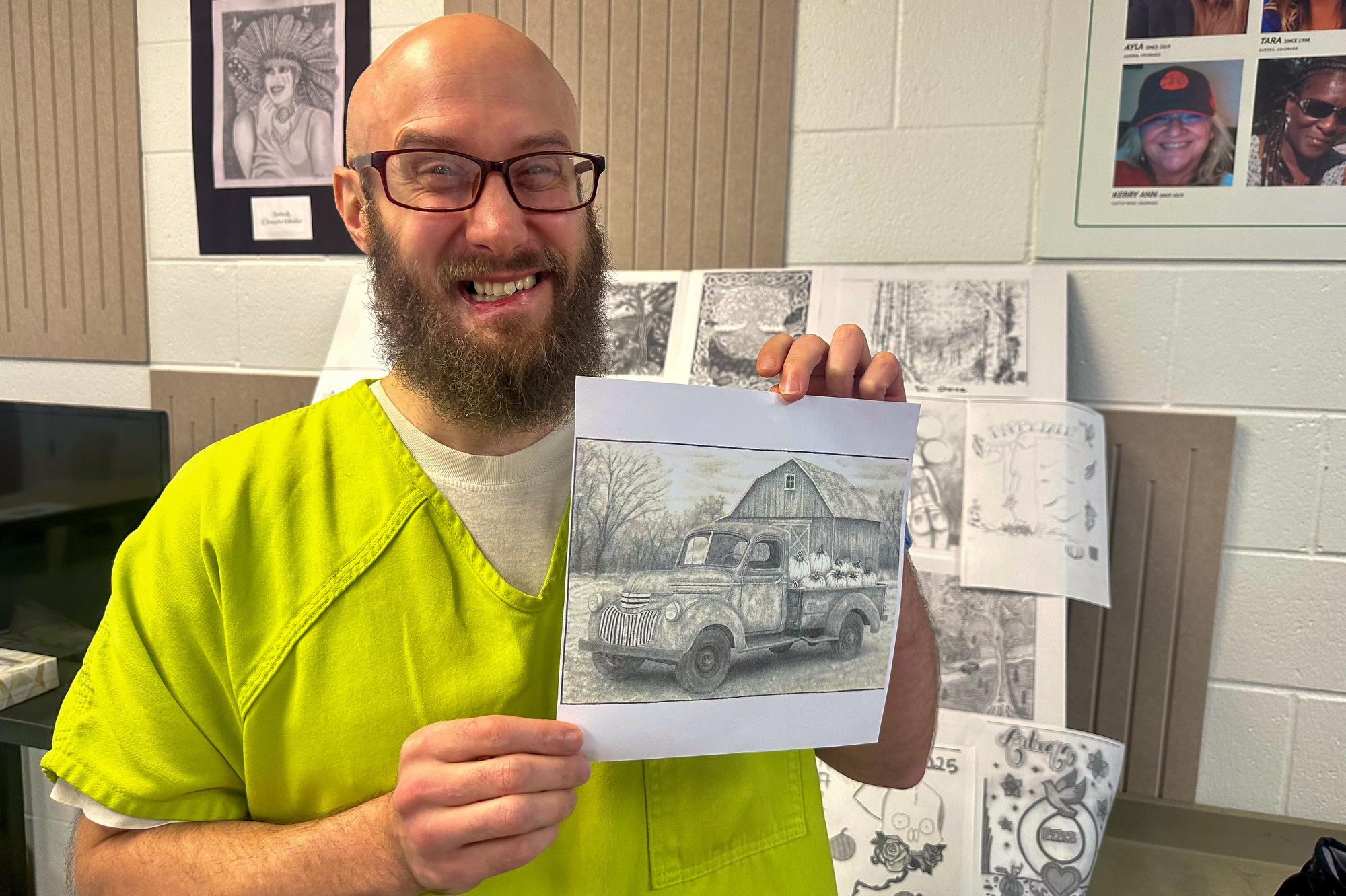
When Victor Jackson looks at one of his whimsical graphite drawings, he’s in awe.
“I'm like: Did I really do that? That looks really good!” he said with a laugh, showing off a photocopy of his Americana depiction of a vintage truck loaded up with pumpkins in front of an old barn.
His amazement is not just about his ability to draw but about where he’s rediscovering his creativity: in jail.
He’s one of a collection of inmates whose artwork is on display in the lobby of the Mesa County Detention Facility. The artists, whose pieces range from an impressionist painting of aspen trees to a detailed drawing of an Indigenous woman, are part of the Substance Use Disorder program, a voluntary 12-week course where they learn life skills.
Jackson is one of several in the program who use art as therapy. He was happily surprised that his piece won first place in a recent jail art show
As he serves his term, he understands how much he needs to improve his life, he said. Making art is part of that journey.
“I feel self-worth. I feel gratitude. I feel encouraged to continue to develop,” he said.
This is a return to aspirations Jackson had long before his incarceration. As a little boy, he would watch his brother draw and would hope he could be as good as him. About a decade ago he decided to try out art himself and began drawing portraits of his family. He thinks he got pretty good — and then just stopped. He still doesn’t know why.
Jackson didn’t come back to art until recently, as he tried to put his life back together behind bars.
When he draws, “I feel love for myself,” he said.
That’s the power of creative release that therapist Michele Wilkie sees daily. She runs the substance use disorder program, part of Jail Based Behavioral Services, which provides mental health care and substance use treatment to incarcerated people in Colorado.

Inmates “need to be able to express themselves, to be able to release the thoughts that they're having,” Wilkie said.
She guides them through meditations, breathing exercises, poetry, art — whatever works for them
“And being able to do that and release that and in a safe spot is huge for them,” Wilkie said.
It certainly has been for Jackson. While in jail, it would be easy “to not do anything” he said.
Instead, because of this program, inmates are “given this opportunity to come and just be able to be human again and be encouraged to grow and develop into the productive member of society that we all need to be,” he said.
He hopes that when people look at their work, displayed in this thin dividing line between incarcerated and free worlds, that they see these inmates as people “with value and virtue” and not just the illegal things they once did.
A bad choice “doesn’t define a person,” Jackson said. “It can refine an individual if they want to.”
Inmates’ work will adorn the lobby of the Mesa County Detention Center through Dec. 19.