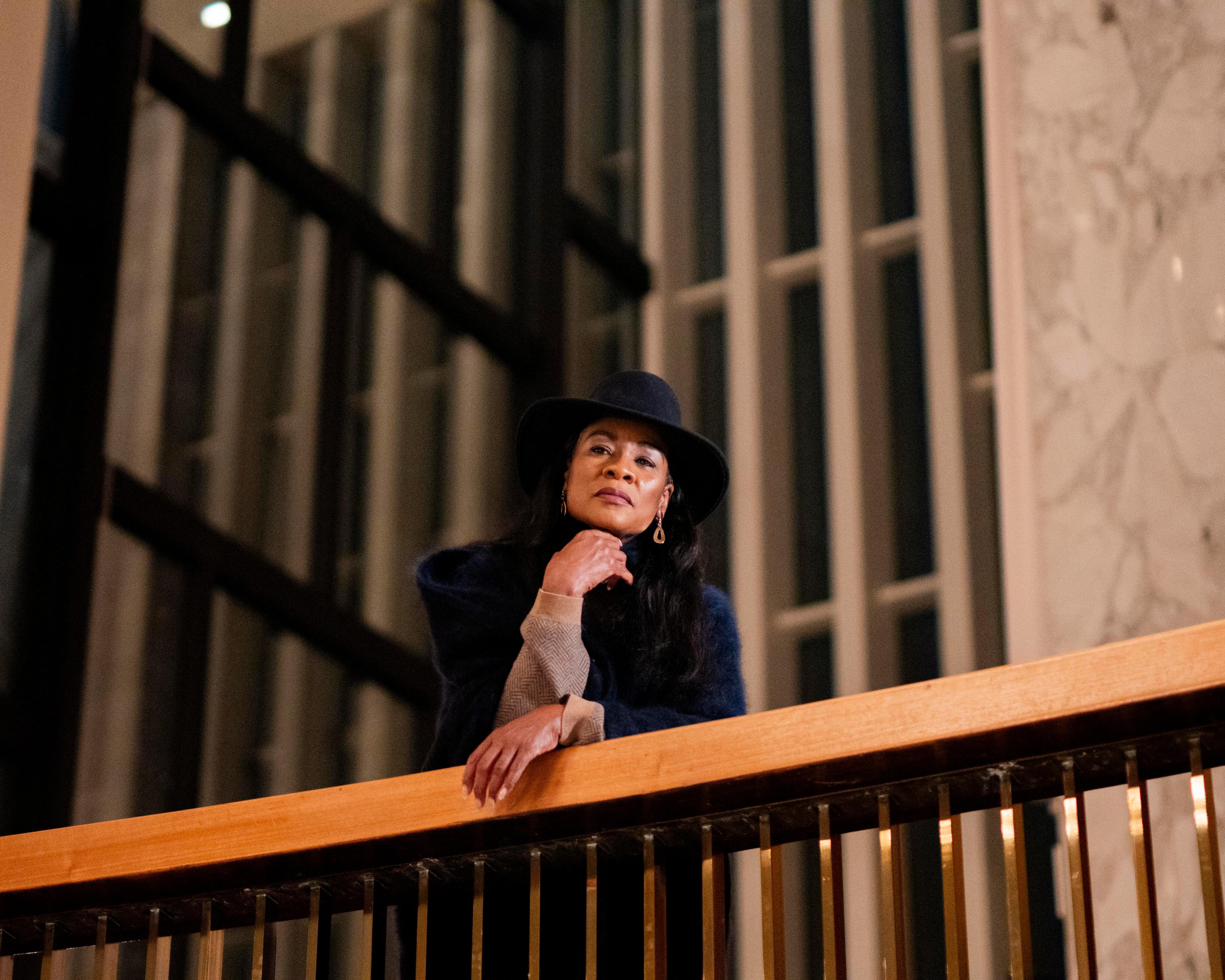
When Denyce Graves was 13 years old, she heard a voice that set her on a path to reach the world's most prestigious opera houses. That incredible voice belonged to soprano Leontyne Price, the first Black opera singer to perform in a leading role in a televised opera.
"I had never heard many other genres of music and certainly not opera. That was as foreign and as strange as anything could possibly be," Graves said in recalling that day she spent listening to Price recordings hours on end with a friend.
"But also to see this woman who looked like us, who looked like a queen... and we heard this type of singing that just split you in half... I was forever changed the moment I heard her."

Now, at 61, Graves is bidding farewell to the stage, taking her final bow on Jan. 24 at the Metropolitan Opera, in her turn as Maria in the Gershwins' Porgy and Bess.
It's a secondary role in an opera composed and written by white men, filled with demeaning stereotypes of Black life. The nearly century-old work has also historically served as a platform for African American singers who otherwise struggled to make a break in a white-dominated industry.
Race problems aside, the mezzo-soprano sees this swan song as coming "full circle" since her very first professional contract was for Porgy and Bess in 1985 at the Tulsa Opera.
The Met "is considered the pinnacle for all opera singers," she told Morning Edition host Michel Martin at NPR's New York studios. "There's no other place quite like it... where you find the world's greatest artists — from directors, designers, choreographers, costume people, you name it."
Graves has portrayed some of the most beloved heroines of the operatic canon, including the seductresses Dalila — in Saint-Saëns' Samson et Dalila — and Carmen — from Bizet's eponymous opera, which marked Graves' Met debut in 1995.


Outside the U.S., she has performed at opera houses from Paris, London and Munich to Vienna and Zurich. The Emmy- and Grammy-winning artist also won the Marian Anderson Award, given to her by the renowned singer.
Graves says she started seeing signs that the time had come for her to finally bid adieu to the stage.
"The body changes, the voice changes, your life changes," she added. "I've done the things that I've wanted to do."

(Winnie Klotz | Metropolitan Opera)
She's planning to focus on teaching, stage directing and leading her foundation, which supports young artists and champions the work of African American artists like Sissieretta Jones and Elizabeth Taylor Greenfield whose contributions she says have historically been "intentionally left out of the telling of the story."
A Washington, D.C. native, Graves is directing the upcoming production of Scott Joplin's Treemonisha at the Washington National Opera, premiering March 7. It will be the company's first performance since splitting from the Kennedy Center earlier this month.
Attendance has dropped since President Trump took over the performing arts venue that's a living memorial to one of his slain predecessors, named himself chairman and more recently had his name added to the building.
Treemonisha, in a new adaptation by composer Damien Sneed and playwright Kyle Bass, will instead be performed at George Washington University's Lisner Auditorium, where the WNO held its first production some 70 years ago.
"For people who have been reluctant or who have actually drawn a line, I hope this will reengage people who enjoy really alive theater to come out and support this work," she said.

"Music can be an agent for peace... I'm interested in that transformative power that can transcend everything — race, socioeconomic status, language, you name it — and that's what I'm choosing to lean into to create."
Julie Depenbrock produced the broadcast version of this story.
Copyright © 2026 NPR
Transcript:
MICHEL MARTIN, HOST:
One of the most difficult decisions a performing artist can make is choosing when to step away. For mezzo-soprano Denyce Graves, that time is now.
(SOUNDBITE OF OPERA, "CARMEN")
DENYCE GRAVES: (As Carmen, singing in French).
MARTIN: After 45 years that have taken her to the world's most prestigious opera houses, she's taking her final bow on January 24. It will be at the Metropolitan Opera in New York after her final turn as Maria in "Porgy And Bess." I caught up with Denyce Graves backstage as she was running through her vocal warmups minutes before going on stage.
GRAVES: (Vocalizing).
(SOUNDBITE OF PIANO PLAYING)
MARTIN: Thank you so much for letting us come while you get yourself ready.
GRAVES: Yeah.
MARTIN: That's amazing.
GRAVES: Look how beautiful you look.
MARTIN: Oh.
GRAVES: Look how beautiful you look.
MARTIN: Well, you know, I had to dress up for you. So...
GRAVES: That's right. You are well put together. Beautiful. Thank you for doing this.
MARTIN: The next day, she joined me at NPR's New York studios to share how it all started for her.
GRAVES: I had just gotten accepted into this performing arts high school. And I was going to class, and I ran into this friend of mine who said, I just heard something that you've got to hear. And so we went to the listening library, and she'd found a recording of Leontyne Price singing Puccini arias.
(SOUNDBITE OF OPERA, "TOSCA")
LEONTYNE PRICE: (As Floria Tosca, singing in Italian).
GRAVES: We cut all of our classes. We didn't eat anything. We didn't drink anything. We never went to the ladies' room. We stayed there all day...
MARTIN: Wow.
GRAVES: ...Listening to Leontyne on a loop. And she and I declared after that moment that that's what we're going to do.
MARTIN: Wow.
GRAVES: I mean, first of all, I'd never heard many other types of genres of music, and certainly not opera. That was as foreign and as strange as anything could possibly be. But then to also see this woman who looked like us and heard this type of singing that just split you in half and changed me, changed my life.
MARTIN: I saw you perform, and your voice sounds sublime to me (laughter).
GRAVES: Thank you.
MARTIN: So why now?
GRAVES: There are a number of things that are pointing me in this direction. I'm very fulfilled. I've done the things that I've wanted to do. I would say that I feel pulled really now in the direction of the work that my foundation is doing.
MARTIN: I also asked Graves about her decision to retire with "Porgy And Bess," which was composed and written by a white man and is filled with stereotypes of Black life.
(SOUNDBITE OF OPERA, "PORGY AND BESS")
UNIDENTIFIED MUSICAL ARTIST #1: (As character, singing) But nobody ain't going pedal no happy dust around my shop. Does you hear what I say?
MARTIN: At the time, George Gershwin stipulated that the opera be performed by an all-Black cast. In part, that was to avoid white performers and blackface, but it also created major opportunities for African American singers.
GRAVES: Oh, my goodness. After COVID, the Metropolitan Opera opened up with Terence Blanchard's "Fire Shut Up In My Bones." And since then, we've seen "Champion." We've seen "Malcolm X." We've seen lots of wonderful stories that tell about the Black experience, that's not "Porgy And Bess." But I had been thinking that I was going to retire soon. When I was offered this role, it seemed like a perfect full circle because my very first professional contract was "Porgy And Bess." That was in 1985.
MARTIN: Denyce Graves has portrayed some of the most beloved heroines of opera, like Carmen and Dalila, around the world.
(SOUNDBITE OF OPERA, "SAMSON ET DALILA")
GRAVES: (As Dalila, singing in French).
MARTIN: She's won numerous honors and prizes, including the Marian Anderson Award. All this from someone who did not start out with a classical music background as a child.
GRAVES: I'm grateful that you think my story is important enough to go out on NPR. This makes me want to cry.
MARTIN: Oh.
GRAVES: (Crying) I'm grateful. I'm so grateful. You know, I think about people like my mother who doesn't have a story that you would find compelling enough to air to your audiences, but who has had an incredible life that should be told.
MARTIN: You're carrying her with you.
GRAVES: Oh, and not only her. My grandmother, those stories of African American artists that we don't know about - you know, Elizabeth Taylor Greenfield, Sissieretta Jones. You know, I owe them a debt of gratitude, and I have a responsibility for that - those individuals who have shaped the industry.
(SOUNDBITE OF OPERA, "SAMSON ET DALILA")
GRAVES: (As Dalila, singing in French).
MARTIN: As a native Washingtonian, Graves called the Kennedy Center one of her professional homes. In February, President Trump took over the performing arts venue that's a living memorial to one of his slain predecessors and named himself chairman. More recently, his handpicked board added his name to the building.
GRAVES: Every day, I'm in conversations about, are we good to go forward?
MARTIN: In the days after we spoke, the Washington National Opera left the Kennedy Center, which it has called home for 55 years. Graves will now direct Scott Joplin's "Treemonisha" at George Washington University's Lisner Auditorium in March. So we followed up with Graves.
GRAVES: And of course, people are entitled to do as they feel. I know that this decision was not an easy one. But for people who have been reluctant or who have actually drawn a line, I'm hoping that this will reengage people who enjoy, you know, really alive theater to come out and support this work.
(SOUNDBITE OF MUSIC)
UNIDENTIFIED MUSICAL ARTIST #2: (As character, singing in non-English language).
GRAVES: Music can be an agent for peace. I'm interested in that transformative power that can transcend everything - race, socioeconomic status, language. And that's what I'm choosing to lean into.
MARTIN: As you retire from performance, what are your treats? What are you - what have you denied yourself...
GRAVES: Pizza.
MARTIN: ...That you are going to have? Pizza?
GRAVES: Pizza. Oh, my gosh. Cheese. Martinis.
(LAUGHTER)
MARTIN: That is mezzo-soprano Denyce Graves. She is planning to retire from performance at the end of the current run of Gershwin's "Porgy And Bess" at the Metropolitan Opera on January 24. Denyce Graves, it has been a delight to speak with you.
GRAVES: I loved this so much.
MARTIN: Thank you so much for talking with us.
GRAVES: Thank you.
(SOUNDBITE OF OPERA, "SAMSON ET DALILA")
GRAVES: (As Dalila, singing in French).
DENYCE GRAVES AND UNIDENTIFIED MUSICAL ARTIST #3: (As characters, singing in French).