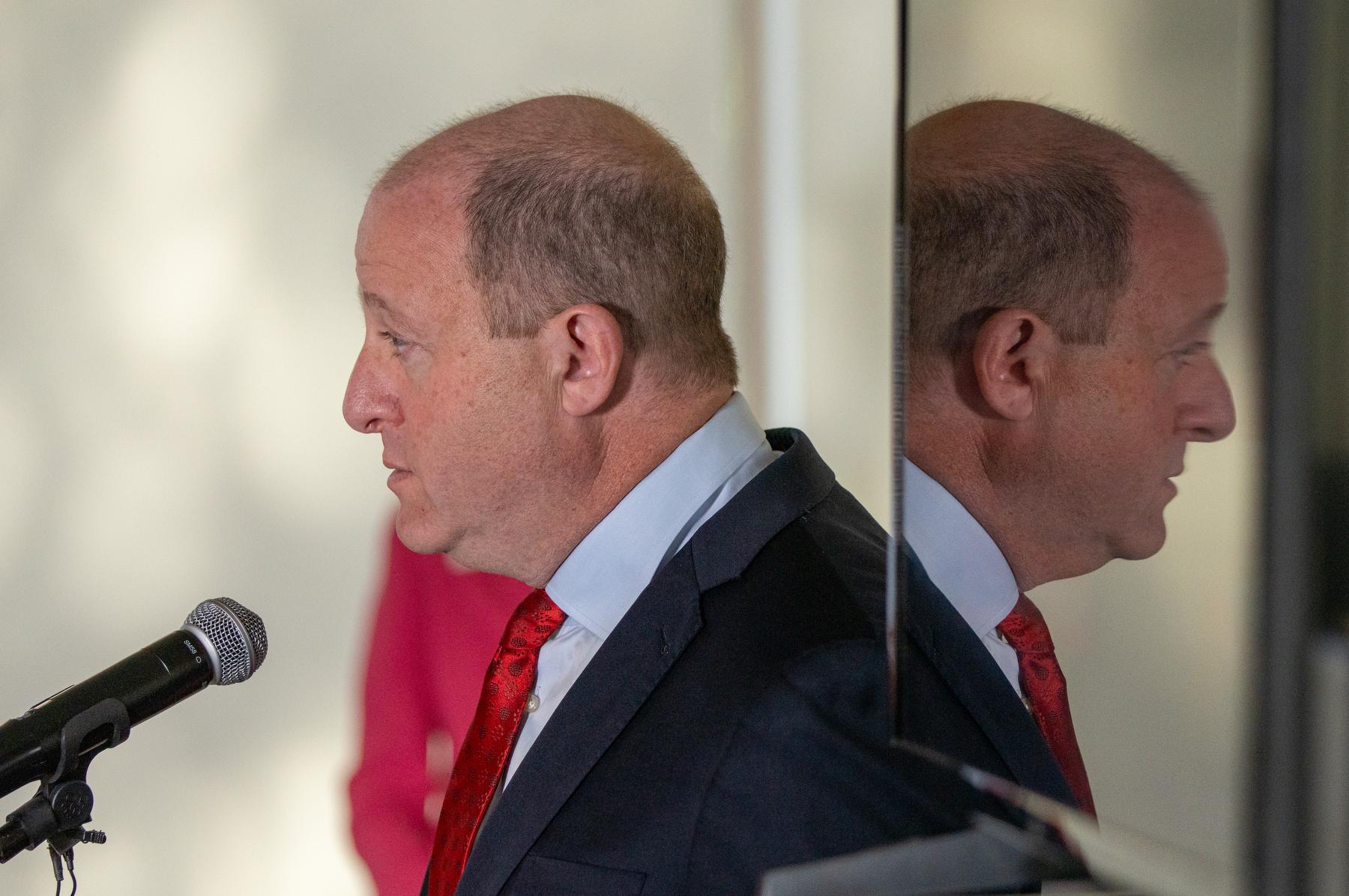
In the seven years Gov. Jared Polis has held pardon and clemency powers, he’s wiped away thousands of marijuana convictions, shortened the sentence of a truck driver who killed four people and even offered a clean slate to the parents of ‘Balloon Boy.’
The governor’s clemency actions, which are typically issued around the holidays each year, regularly draw news coverage and sometimes criticism, as was the case after Polis shortened by a full century the sentence of Rogel Lazaro Aguilera-Mederos, the truck driver who caused the fatal 28-car crash in 2019. Polis’ pardon authority is again drawing national attention, this time as it relates to former Mesa County Clerk Tina Peters.
Peters was sentenced to more than eight years in state prison for her role in allowing unauthorized access to Mesa County voting equipment. Peters is currently eligible for parole on Dec. 20, 2028, but could be released earlier. According to Colorado Department of Corrections policies, inmates are eligible to move into community corrections 16 months before their parole eligibility date.
President Donald Trump has since taken up her cause. Trump has called for her release, directed the Department of Justice to work on her case, and publicly criticized both Polis and the Republican District Attorney who prosecuted Peters’ case.
For his part, Polis has not said if he would pardon or commute Peters’ sentence. In September 2025, he rejected the notion of releasing Peters in exchange for more favorable treatment from the Trump Administration.
“In a past version of America, people have gone to jail for that,” Polis told Colorado Matters Senior Host Ryan Warner at the time. “Isn't that something people should go to jail for, Ryan? If that happens, I mean, that's the America we need to get back to.”
Since then, speculation that Polis might commute Peters’ sentence has grown as the Trump Administration has ratcheted up pressure on the state, vetoing clean water bills and declining disaster declarations. Amid the controversy, Polis has maintained he would consider a request from Peters the same way he would any other.
“When you look at people who have been convicted for nonviolent, first-time offenses, absolutely, her sentence stands out,” Polis said in a recent interview with Colorado Matters. “I think there's no question about that, and we have hundreds of applications for clemency and for pardons — and I thoughtfully review each and every one of them. And in my final year as governor, I do want to lean into the value of mercy and do what we can to give people a second chance.”
Pardons amount to a complete forgiveness of a crime and include restoration of civil rights. Polis has used the pardon power extensively, particularly in cases of past marijuana crimes or decades-old infractions committed by residents when they were young.
Commutations are less common for the governor. In that act of clemency, someone convicted of a crime is released ahead of schedule. One of Polis’ earliest commutations was for a man who committed millions of dollars in securities fraud and received a 100-year sentence. In either process, an offender submits an application that will be forwarded to the state’s director of executive clemency. Applications are then reviewed by the clemency board, and recommendations are forwarded to the governor.
In recent years, Polis has issued more commutations for sentences that he described as being “excessive” or “well beyond the typical range” for other infractions. That pattern of shortening sentences — in addition to public statements calling Peters’ sentence “harsh” — is prompting speculation that Polis could similarly shorten her time at the La Vista Correctional Facility in Pueblo.
Polis’ clemency record includes 25 commutations and thousands of pardons, according to his office. Many of those are for possession convictions, including 4,083 for marijuana and four for psilocybin. Polis also granted commutations to three individuals who were sentenced to death after Colorado banned the death penalty. Those sentences were commuted to life without the possibility of parole.

To get a sense of how a request from Peters might align with past cases, CPR News examined pardons and commutations granted by Polis since he took office in 2019.
Considerations for age and health
In the countless times Polis has been asked about Peters, he’s mentioned that he considers age and health as factors in requests for commutations.
Those advocating for Peters, including Trump, regularly point to her age as a factor. Peters is 70 and, according to Colorado Department of Corrections data, the state only had 78 female inmates over the age of 60 as of the end of 2025.
In 2020, Polis commuted the sentence of an 84-year-old man who had served 31 years of a life sentence. The man, Anthony Martinez, used a wheelchair and struggled with dementia, deafness and blindness.
“While his case highlights the need for reforming the state’s special needs parole process for him and others like him, at least I am able with my power as Governor to be a last recourse to allow him to live his final years with his niece in Pennsylvania,” Polis said at the time.
Commuted, but not freed
The governor’s most notable instance of shortening an offender’s sentence while not immediately releasing them from jail involved Aguilera-Mederos, the truck driver involved in the fatal crash on Interstate 70 in Lakewood.
Before Polis shortened that sentence, prosecutors were in the process of asking a judge to reconsider the sentence and impose a much shorter one. Polis’ decision to preempt that process prompted a letter criticizing the decision from two Colorado District Attorneys who argued the courts should have been allowed to finish their work. Twenty-first Judicial District Attorney Dan Rubinstein, who prosecuted Peters, was one of the letter’s authors.

In 2023, Polis shortened a number of sentences for offenses ranging from robbery to drugs, oftentimes pointing to concerns about unequal sentences. In some cases, it was because of changes in laws that would have allowed for a shorter sentence to be issued or in cases where a sentence that was handed down was extreme compared to other, similar cases.
In one instance, Polis shortened the sentence of a man convicted of robbery and weapons charges because the court rejected an amended sentence agreed to by the defense and prosecution in the case. In another, Polis drastically reduced the amount of prison time for a man convicted of burglary and theft.
“A 144-year sentence for the crimes you committed is excessive for property crimes, as it is more time than most receive for more serious charges such as murder,” Polis wrote in the commutation letter for David Heckman. Heckman is now parole eligible in 2028. Originally, his mandatory release date was Oct. 9, 2146.
Accountability
Peters has not publicly expressed remorse for the crimes she was convicted of and has long maintained she had every right to do what she did. A key point of her ongoing appeal is that she should have been allowed to argue to the jury that she committed the infractions because she was attempting to preserve election records.
At her sentencing — which is being challenged by Peters’ attorneys as a First Amendment violation — 21st Judicial District Judge Matthew Barrett described her “as defiant as a defendant as this court has ever seen.”

Asked earlier in January if contrition factored into clemency requests, Polis said it was one of many considerations.
“There's many factors I look at in clemency, so one of them you look at was it violent or not? One of them you look at is was it a first-time offense or is it a habitual offender? I also look at age and disability and health and you look at, also, whether people take accountability for the crime,” Polis said. “So some people I've looked at have some or all of those attributes and those are the types of things that I look at in any clemency review that I do.”
However, nearly every commutation letter Polis has written so far nods toward accountability and remorse.
“You have taken accountability for your actions and recognize the mistakes you made in the past. You are remorseful and ready to advance to a new phase of life,” Polis has written in commutation letters for every year that he’s issued them.
Timing
Historically, Polis has issued commutations and pardons around the end of December in each of the years he’s been governor. He did not do so in 2025, however.
A spokesperson for Polis said the deviation from tradition had to do with an effort to review as many cases as possible with due diligence.
“While in years past the announcement has come before the end of the year, there is no set timeline and the Governor does not want to rush the process,” A spokesperson for the governor said. “Review of all applications is an important part of the process. All applications must be submitted by April 3, 2026.”
Peters’ attorney, Peter Ticktin, told CPR News that he submitted a clemency request to the Governor’s office, but did not provide a copy of the document. The Governor’s office said clemency applications and related materials are confidential and available solely to the Governor and the Governor’s staff.