
Updated 11:48 a.m.
With Christmas only a few days behind us and New Year’s coming up, Colorado is being rocked by a wave of influenza unlike anything it’s seen in years.
That has sent hospitalizations skyrocketing.
The ominous trend is reminiscent of the worst surges of the pandemic, with a variety of metrics on the state’s viral respiratory diseases dashboard all blinking red. This time, however, it’s not COVID-19, but flu, which is also now circulating widely in the U.S.
Nearly 800 people (782) in Colorado are now hospitalized with flu, that’s almost 250 more than a week ago, 430 more than two weeks ago and 12 times the number the state recorded in mid-November.
The total is almost 300 more than last season’s peak of around 500 in early February.
The numbers are in record-shattering territory. This same week in 2014, 582 people were hospitalized with flu, in what was the worst recent season in Colorado. That’s according to the state health department’s 2015 flu season annual report.
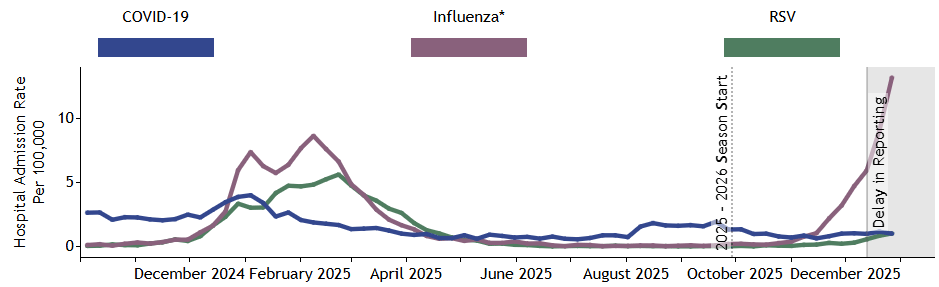
“The 782 new flu-related hospitalizations reported for the week ending Dec. 27 is a record for raw numbers of influenza hospitalizations reported in one week since we started tracking influenza hospitalizations in 2004,” said CDPHE spokesperson Hope Shuler, in an email. “We saw a similar rate of hospitalization (40 per 100,000) during the 2024-2025 season, but that figure wasn’t reached until roughly four weeks later, in late January.”
The line on this week’s flu hospitalization graph is now nearly vertical, charging almost straight up on the website of the Colorado Department of Public Health and Environment that tracks viral activity, which was updated Tuesday.
Shuler said the agency expects hospitals can handle the wave with increased staffing and surge capacity to manage increased volume. “We expect hospitalizations to continue to increase in the immediate future as a result of recent holiday gatherings and return to school, child care and work,” she said. “At this time, hospital bed capacity for adults and pediatrics remains within the ranges we would typically expect during this time of year.”
The flu season in Colorado began about four weeks earlier than usual, which follows trends seen internationally this year in the UK and Japan.
“We're continuing to see steadily increasing numbers of kids with the flu with no end in sight. Just by sheer volume, that's led to larger than normal numbers of our patients hospitalized or in the ED (emergency department) with flu-related complications like pneumonias, dehydration, and respiratory distress,” said Dr. Shen Nagel, a pediatrician with Wheat Ridge clinic Pediatrics West, via email.
“We've seen a lot of our patients where flu has ripped through the whole family including higher-risk relatives like grandparents or young babies,” he said. “The only saving grace thus far … has been that other respiratory illnesses such as RSV and COVID haven't exploded yet, so thus far, no ‘tripledemic’ repeat,” Nagel said.
The number of tests coming back positive, called the weekly sentinel positivity rate, is nearly 34 percent, which means many are testing positive for flu when they show up coughing, sneezing and sniffling in hospitals, urgent cares, clinics, community health centers and doctor’s offices.
Almost 10 percent of visits to hospital emergency departments are now being diagnosed with flu and it’s showing up in all of the 21 utilities monitoring for it in wastewater.
Individual systems are tracking the increases.
“As of yesterday, across our system we have 152 patients hospitalized with flu, so we’re trending higher than last flu season, when our peak was 114 in early February,” said Kelli Christensen, public & media relations Director with UCHealth.
Overall respiratory illness activation in Colorado is high, according to the website. The only bright spot is that so far, hospitalization for COVID-19 and RSV have remained relatively flat, with both recording about 60 hospitalizations each. But those viruses bear watching too, since all the key metrics for them are also on the rise.
Colorado’s flu boom mirrors what is being seen nationally, with cases rising sharply.
According to the Centers for Disease Control and Prevention, last week more than 19,000 flu patients with influenza were admitted to hospitals, which was an increase of around 10,000 from the prior week, according to new CDC data.
The agency estimated some 7.5 million people have been sickened, and over 3,100 people have died from the flu.
In Colorado, one child has died from the flu. CDPHE last week confirmed the death, an elementary school-aged child from metro Denver, as the first influenza-associated pediatric death of the 2025-26 viral respiratory disease season.
CDC recommends everyone 6 months and older who has not yet been vaccinated this season get an annual flu vaccine. Approximately 130 million doses of influenza vaccine have been distributed in the United States this season, according to the agency’s website.
Despite all the news of flu illness, Coloradans are so far not taking the step that doctors say provides the best protection: getting immunized.
The state’s immunization numbers are woefully short of what public health officials and doctors say would provide much better community protection.
Twenty-seven percent of Coloradans, about 1.5 percent less than this time last year, have received a flu vaccination this season, according to the state’s dashboard.
A little less than half (49%) of one of the most vulnerable groups, those 65 and older, have gotten a flu shot. Of those 6 months to 9 years old, 29 percent have gotten a flu vaccine; just about 20 percent of those 10-19 years have gotten it.
Hispanic Coloradans are trailing other racial and ethnic groups with just over 7 percent having gotten immunized, according to the dashboard.
Nagel said doctors and public health workers are having to clear up some public misunderstandings about this year’s vaccine.
“There's been a lot of publicity about the ‘mismatch’ between the vaccine and circulating strains and, unfortunately, it seems far less about the data that even the mismatched vaccine provides up to 50-75 percent reductions in serious illness or hospitalization, especially in children,” he said.
“And shorter illnesses can lead to less contagious time and decrease overall spread. So our ongoing discussions with holdouts have had to counter the resistance based on misperceptions that the vaccine isn't helping this year.”
While the H3N2 subclade K strain — the current dominant flu strain circulating — is a slight mismatch to this year’s vaccine, early data remains “very encouraging,” Shuler said. “The vaccine is still performing well where it matters most, preventing about three-fourths of pediatric hospitalizations or emergency care and about a third of adult hospitalizations or emergency care.”
Everyday precautions
The vaccine, along with taking precautions to prevent infection, remain the most effective tools to prevent severe illness and hospitalizations, Shuler said.
She suggests Coloradans can take everyday prevention measures to help reduce the transmission of respiratory illnesses:
- Stay home when sick.
- Cover coughs and sneezes with a tissue or your shirt sleeve, not your hands.
- Wash your hands often with soap and water for at least 20 seconds, or use an alcohol-based hand sanitizer with at least 60% alcohol.
- Avoid touching your face with unwashed hands.
- Avoid close contact with others who are sick, such as kissing, shaking hands, and sharing cups and eating utensils.
- Clean and disinfect frequently touched surfaces, such as doorknobs and mobile devices.
Some people may choose to wear a mask for protection from respiratory viruses. “Be respectful of everyone’s choices,” she said.