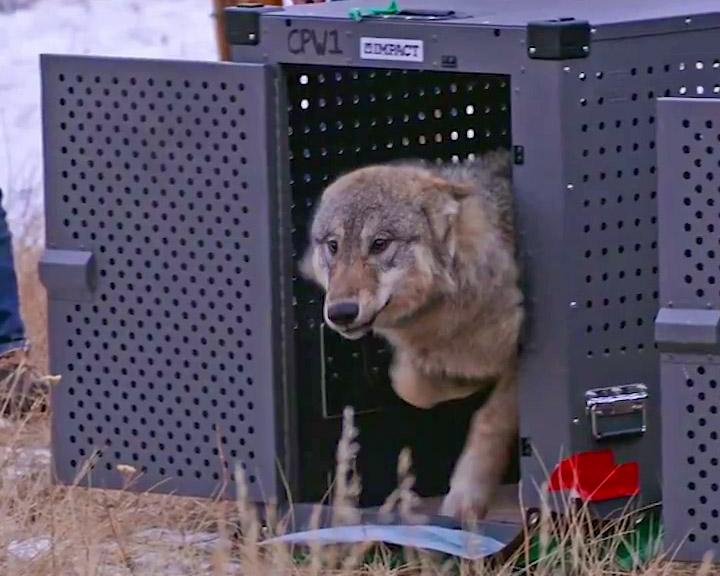
A gray wolf brought to Colorado more than two years ago died in Routt County during a routine operation to capture and collar the animals, Colorado Parks and Wildlife announced in a press release on Tuesday.
The wolf, 2305-OR, was part of the original batch of predators captured in Oregon as a part of Colorado’s voter-approved wolf restoration program. Since its release, the male found a mate and formed the King Mountain Pack in Routt County by fathering a litter of pups last spring.
It’s unclear how the capture operation on Jan. 28 might have killed the animal. In its previous collaring operations, wildlife managers have darted wolves with a tranquilizer from a low-flying helicopter, then attached the tracking devices. CPW plans to perform a necropsy — the technical term for an animal autopsy — at its lab in Fort Collins to determine if any underlying conditions may have contributed to its death.
“All wildlife capture operations come with a risk, and while we meticulously prepare and take every precaution to ensure a positive outcome, there is always the possibility, even if small, that the worst happens,” CPW Acting Director Laura Clellan said in the press release.
The same operation successfully collared the pack’s female breeding adult and a pup. A summertime count conducted by CPW confirmed the pack had four pups. All four were observed during the recent capture operation, according to the recent press release.
CPW uses collars to track wolf locations and proactively deploy range riders or other resources if the animals get too close to livestock. The agency aims to keep at least two wolves in each pack collared, and both breeding adults in the King County Packs were released with working tracking devices. Those devices, however, had low batteries, according to the press release.
State wildlife managers have struggled to protect wolves brought into Colorado as part of the controversial restoration effort. Out of the 25 wolves brought to the state, 12 have died. Another two wolves born within the state have also failed to survive, bringing the death toll to 14.
The latest death comes after the federal government intervened to stop Colorado from reintroducing another batch of wolves from British Columbia this winter. The U.S. Fish and Wildlife Service is now considering whether the state violated its permit to manage wolves by importing 15 wolves from Canada in January 2025.
Other states and tribal nations have refused to offer any wolves currently living within the U.S. Without an additional infusion of animals, Colorado must protect its current population of wolves to support its goal of seeding a viable wolf population more than 80 years after hunters and trappers eradicated the species.
The death makes it far less likely that the King Mountain Pack will birth more pups moving forward. A 2014 study found that 77 percent of wolf packs dissolved after losing a breeding adult. Other research, however, has found that packs often recruit other breeding adults into their ranks after losing an adult member.
CPW continues to monitor three other confirmed packs along with the King Mountain Pack. If those family groups have additional pups this spring, the agency will report an updated minimum population estimate in an annual gray wolf report set for publication in early summer.