
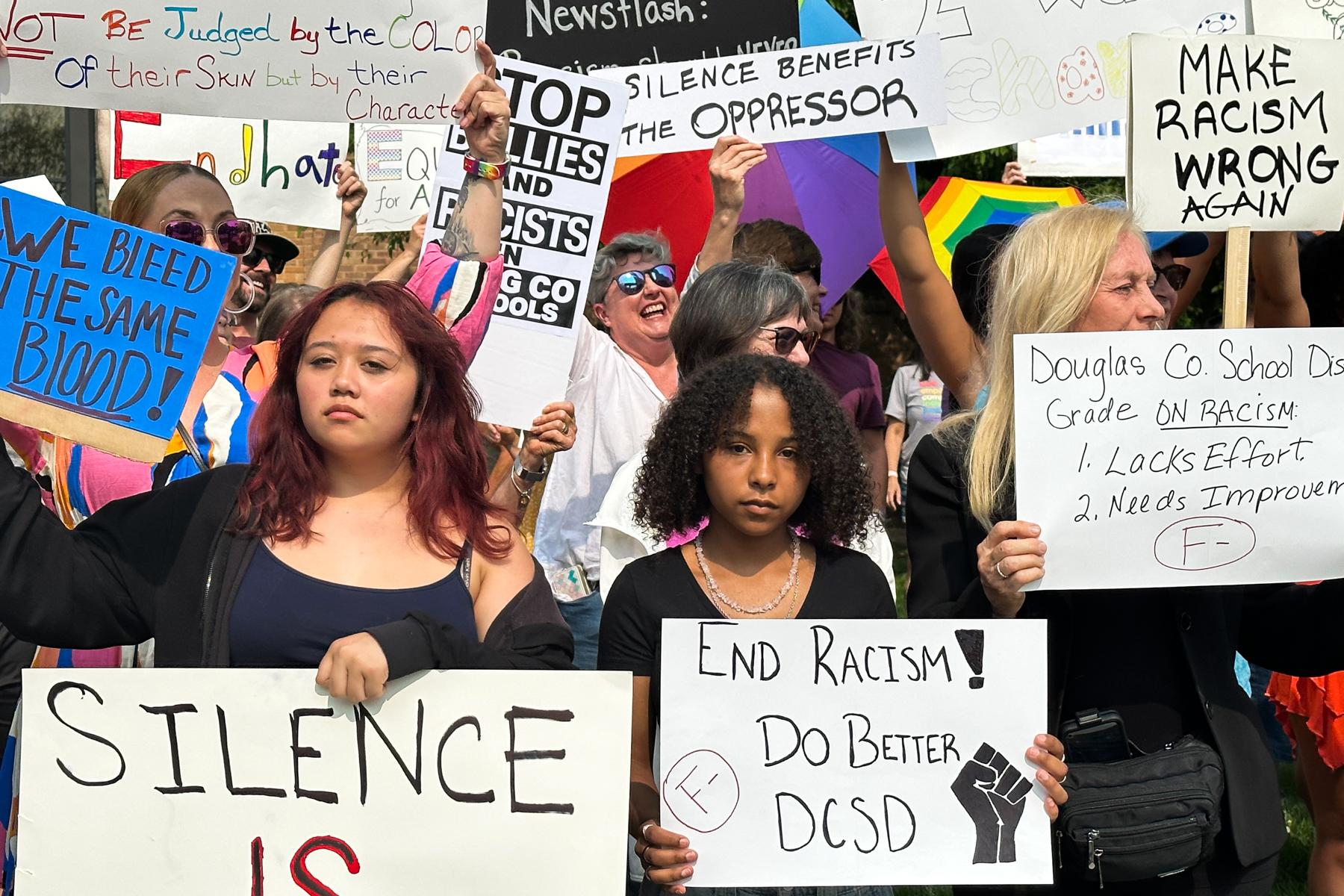
The Douglas County School District is asking a federal judge to rule that there isn’t enough evidence for a high-profile case — brought by four families who say their Black and biracial children faced repeated racial harassment in middle and high school — to go to trial.
In order for a summary judgment, the district must show that no reasonable jury could find that a district school was deliberately indifferent after learning about racial harassment in classrooms, hallways and chat groups. The district argues it responded appropriately to each incident it knew about and can’t be held responsible for misconduct that was never reported to school administrators.
The lawsuit filed in 2023 alleged the racial discrimination experienced by several students between 2020 and 2023 was inadequately addressed by the district. One student, then 14, alleged he faced pervasive racism and bullying at Castle Rock Middle School. A group Snapchat used by more than 100 students targeted and bullied Black and biracial students with racially derogatory, humiliating racist tropes and offensive slurs.
The students experienced verbal insults, racist jokes and threats of violence, according to the lawsuit. The student wrote a letter to the district describing the racism he’d experienced and asked for help to no avail. Their suit says the students endured a hostile education environment where racial slurs and offensive jokes were common. They claim the district minimized the severity of what happened and didn’t put adequate protections in place to prevent further harassment.
In a 266-page motion, the district argues there isn’t the evidence to meet the legal standard to merit a trial. It argues it responded every time it was told about racial slurs and bullying and alleges much of what the families describe was never reported to administrators. The district describes each student’s incident and the steps it took in response. It says the plaintiffs have not shown they will succeed on federal Title VI and equal protection claims.
The suit is based on Title VI, part of the Civil Rights Act of 1964, which says the public schools can’t discriminate on the basis of race, color, and national origin.
There is a second equal protection claim in the suit, alleging that the racial hostility and harassment experienced by Ganzy and two other Black students at Castle Rock Middle School happened so often and in so many different forms that it deprived them of equal educational opportunities.
Prompt response
In court documents, the district claims that its responses to incidents were prompt and reasonable. It says it disciplined students, contacted parents and offered students an alternative educational arrangement. The district alleges there is no evidence showing it tolerates or promotes or fails to address race-based discrimination.
The district argues that each plaintiff’s claims should fail under the “deliberate indifference” standard. Families must show the school knew about the serious racial harassment but didn’t take reasonable steps to stop it.
The lawsuit mentions the students only by their initials.
When a student allegedly called another student N.G. a derogatory name in P.E., a teacher immediately took that student to the office, checked on N.G. and the student received one day of in-school suspension, the motion stated.
The motion describes how another student, C.M. was called a racial slur in gym, which led to the offender being given a three-day out-of-school suspension. After other hallway altercations, the district provided an escort plan so C.M. could move between classes with an adult. It says when C.M.’s mother raised concerns about bullying and Snapchat posts, she couldn’t provide screenshots. The child was eventually excused from attending the last weeks of school without academic penalty.
When J.G. showed the school the racist Snapchat posts, the district argues the school immediately investigated, notified the compliance office, held a restorative meeting, and helped him transfer to an online school when his mother chose not to return him.
Finally, the district says it implements robust policies on nondiscrimination, educational equity and bullying prevention. It maintains that it trains staff to report potential violations of discrimination policies. harassment.
Not fast enough
Families maintain that the district didn’t act fast enough to uncover or stop the racist Snapchat group that was operating for a long time. They argued the district should have seen that racial harassment was happening in hallways, buses, group chats and locker rooms. The families say the district placed too much responsibility on students, some of whom were 11 or 12, to make formal complaints. They argue the harm to their children was significant and long-lasting.
The retaliation was so relentless that the stress from the non-stop racial discrimination gave C.M. such excruciating abdominal pain that his parents took him to the emergency room, according to the suit.
The lawsuit alleges that the district and school board acted with “callous indifference” despite explicit knowledge of the hostile environment. It states that the school’s principal failed to properly train, monitor, supervise, and discipline teachers and students about racist harassment and abuse or to investigate and respond to such allegations.
Iris Halpern, the families’ attorney, said the school district could have simply done the right thing long ago — apologize, and revisited the policies and practices that led to such horrific discrimination against its own students in the first place.
“Dragging out litigation does nothing to strike at the heart of the problem, and in fact sends the opposite message to minority students – that the school district does not welcome racial minorities, their education does not matter to it, and that the district would rather waste its resources defending inequality instead of fighting it.”
She said she is confident the school district’s summary judgment will be rejected as was its earlier motion to dismiss.
A federal judge will now decide whether the evidence is strong enough for the case to go to trial.