As Venezuela and the United States navigate next steps following the ouster of President Nicolás Maduro last weekend, we spoke with University of Denver professor and Venezuela expert Francisco Rodriguez to provide historical context on current events. Rodriguez, author of “The Collapse of Venezuela: Scorched Earth Politics and Economic Decline, 2012–2020,” talked about the boom and bust cycles of Venezuela’s oil economy and what led to the country’s most recent economic failure.
Here are some takeaways from the interview:
This conversation has been edited for length and clarity.
On the US motivation for Maduro’s ouster:
This is one case where you can't just simply go by the policy statement…President Trump and Secretary Rubio have been saying Venezuela should stop sending fentanyl to the US. Well, Venezuela doesn't produce fentanyl. They’ve said Venezuela should stop exporting cocaine. Well, Venezuela is a transit route for cocaine, primarily not to the US, and it's by far not the largest one in Latin America. So if you wanted to focus on cocaine drug trafficking, you should be focused on Ecuador, Peru, Mexico.
So, is it about immigration? The Maduro government was perfectly willing to accept as many deportation flights as the US wanted to send there. Is it about oil? Now, the US does say that it's about oil, and that is a possibly a much more truthful characterization of what their intentions are. What we do know is that it doesn't seem to be about democracy. President Trump did not mention the word democracy once in his press conference after the arrest of Maduro. It seems it’s partly about taking out a character, Nicolás Maduro, who had become completely toxic, who was seen as the embodiment of the Latin American dictator.
On the precedence of removing a head of state:
There are norms that govern the relations between countries and there's an expectation and obligation in the UN charter that countries will respect the territorial integrity of other countries. The international community and the United States very strongly condemned the 2022 invasion by Russia of Ukraine. It’s not to say that some of the claims or demands that Russia was making were entirely unfounded because these territorial disputes are very complex.
But what the international community was saying is that differences are resolved peacefully and you don't resolve differences by trying to control the territory of another country. This was a very clear violation of international law by any standard. There are 84 countries in the world that live under dictatorship. Seventy-five percent of the world's population lives in those countries. So what are you gonna do? Take out all of those dictators? The reality is, whether we like it or not, the world has a lot of authoritarian leaders, and many of them are US allies.
However, the fact is that taking out Nicolás Maduro was very popular among the Venezuelan exile community, among the Cuban exile community and among Florida voters.
On how oil has factored into the Venezuelan economy in recent decades:
This is an economy that has been dependent on oil. Since the early 20th century, oil has accounted for more than 90% of the economy's exports and for more than 40% of its government revenue. If you look at the swings in Venezuela's economy over time, they're all oil shocks. In the 1970s when oil prices went up from $3 a barrel to $12 a barrel, and then to $25 a barrel, Venezuela experienced a huge boom. In the 80s and 90s, when oil prices went back down to $8 a barrel, the country went into crisis. That was the crisis that helped Hugo Chavez get elected.
But in the last decade, another phenomenon occurred, which is that oil production started to decline significantly because of lack of investment and deteriorating infrastructure. The US economic sanctions also played a very significant role. The US came in with sanctions in 2017 and then even more stringent sanctions in 2019 and 2020. So what happened during the late 2010s is that this economy went into a tailspin that generated the largest economic contraction ever seen in any economy in the world outside of wartime.
On what happened to ordinary Venezuelans when the economy collapsed:
It was horrible. Per capita income fell by 71%. Poverty skyrocketed to more than 90%. Malnutrition, which was non-existent in Venezuela, rose to 25% of the population. The country just simply wasn't able to feed itself, and that's why eight million Venezuelans left – one quarter of the population.
Then Maduro becomes very unpopular because he's presiding over the country as the economy’s collapsing. He still has supporters and they say the economic problems are because of the sanctions, the blockade. But his opponents say it's because you ran the economy into the ground. And there's an element of truth to both. But that's where, in a terrain of very polarized politics, where the opposition is angling for a way to gain control of a very powerful state, you get the situation where they start morphing into this authoritarian state and the dictatorship Venezuela has become.
On what happens to the eight million Venezuelans who left the country (including 40,000 Coloradans) now that the administration ended the Temporary Protected Status program:
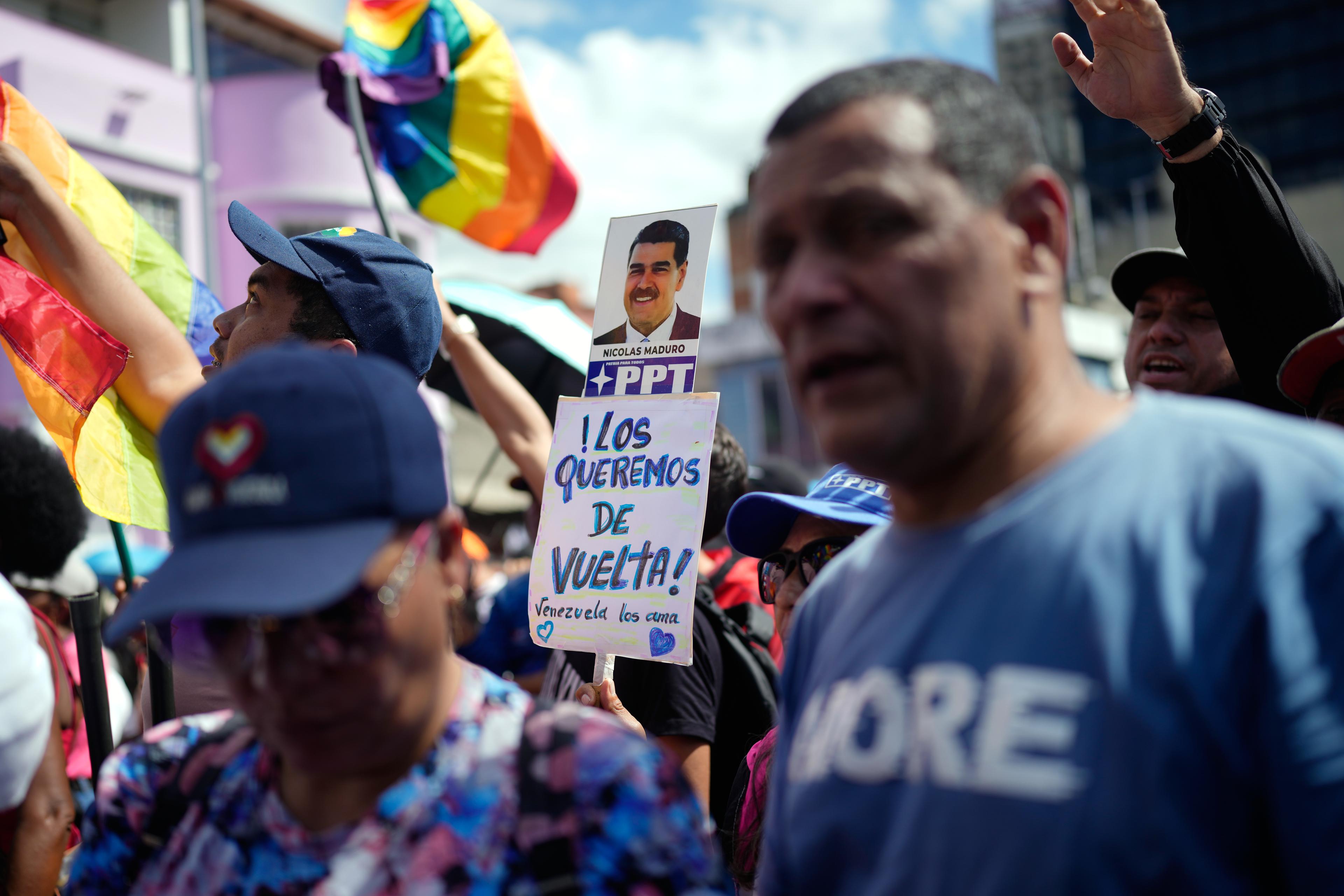
Venezuelans have to leave or decide to stay in the US illegally with all of the risks that carries and this has generated frustration and just a lack of understanding of what’s happening in the Venezuelan population. On the one hand, there were many Venezuelans who liked Trump because Trump was seen as the one who was gonna be tough on Maduro and to a certain extent, he was. He took Maduro out and Venezuelans are happy because of this.
But this is the same Trump who has called for mass deportations of Venezuelans and who sent 250 Venezuelans to an infamous prison in El Salvador. There's strong evidence now from their testimonies that they were subject to brutal tortures. And it's the same Trump who has said, we're gonna blow up these boats in the Caribbean because we say that they're drug traffickers, violating every single rule of military engagement, due process and basic human rights. So Venezuelans are very ambivalent about this Trump figure.
But they're very afraid because now they're being told that they're gonna be deported, that they should go back. Even the Department of Homeland Security recently said Venezuelans can now go back to Venezuela and most Venezuelans say, you're telling me to go back to a country that I left because it was a living hell, and it continues to be a living hell.
On whether we’ve entered a new era in US-Latin American politics and what that means for Cuba:
I do think the Trump administration and Secretary Rubio have been clear that Cuba is part of their objective and that they see Cuba as coming next. That doesn't necessarily mean that the US is gonna do the same thing in Cuba. The Cuba strategy might be different.
I think that part of the strategy here is one of collapsing the Cuban economy through collapsing the Venezuela economy, or through collapsing trade between the two countries. The Trump administration has been very clear that they view themselves as inheriting the tradition of the Monroe Doctrine. And the idea here is that the US has power, has authority over everything that happens in the Western Hemisphere.
In the past, the US justification was, it's communism, it's the Cold War, we have to protect our hemisphere. That's why after the fall of the Berlin Wall, Republican and Democratic administrations started treating Latin American nations as equals, had relationships based on mutual respect, and also most of Latin America transitioned to democracy during that period. So that means that these governments were inherently legitimate. Now the US is completely going back on that tradition and saying we decide what happens here.
On whether the US action in Venezuela gives the green light to other countries to do something similar (for example, China in Taiwan):
I think it definitely does. The US has just broken a basic rule of international engagement, which is that you don't violate the territorial integrity of other countries. Now you could say, the first to break those were the Russians and the position of the Trump administration here is quite curious because they seem to be saying it's okay for the Russians to have done that. We're not going to treat Russia's invasion of Ukraine as a violation of international norms. We're gonna treat it as a conflict between two countries in which we're gonna try to get them to strike a peace deal.
Then comes the question of what happens if China does decide that it's going to invade Taiwan. I don't think that the US is going to react. First of all, the US has already shifted a significant amount of its naval and air power to the Caribbean so its response capacity to confront China in another scenario is limited. But also the US has effectively broken up the coalition that could have responded to a Chinese aggression in Taiwan. The US does not have the leadership necessary now to get Europe and the rest of the free world to say to China, you can't do that, because China and a lot of the world is going to say, what do you mean you can't do that? You just did that yourself.
As a Venezuelan, I was happy to see Maduro behind bars. That's what many Venezuelans have wanted for years. But what I'm not happy about is to see a world in which the US and then China and then Russia, and whoever wants to, is gonna decide that it's going to invade, it's gonna change the leaders of other weaker countries. I think we may be walking into an era of much greater international conflict with fewer countries able to chart a course that is independent from that of the great powers that are dominant in their area.