Updated at 12:27 p.m. on Wednesday, Jan. 14, 2026.
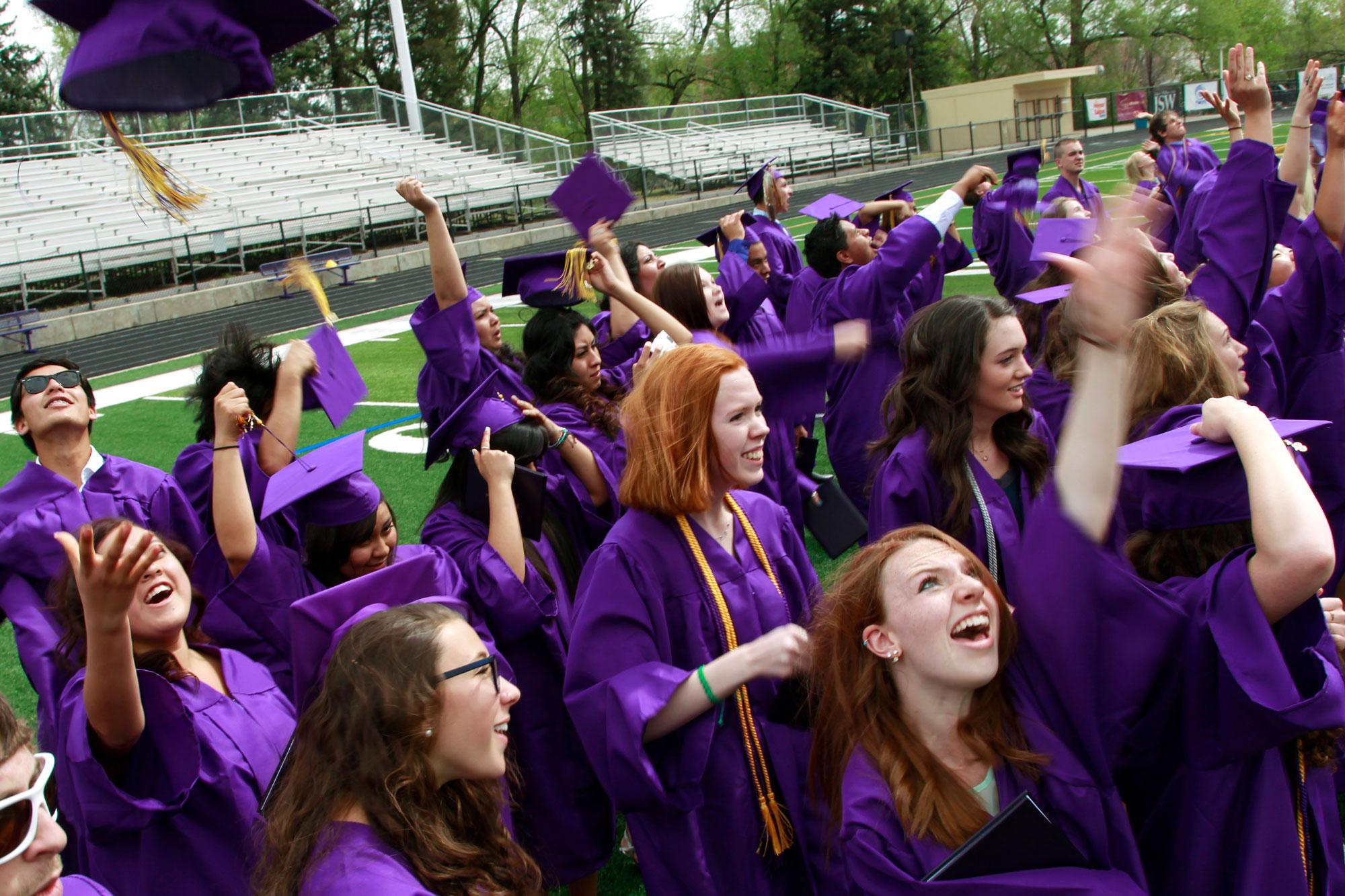
Colorado’s high school graduation rate inched up in 2025 to the state’s highest level in more than a decade. Student dropout rates are also declining, but large differences between student groups persist, according to new data from the Colorado Department of Education.
The department also released enrollment data showing the school population declined by about 10,000 students. Enrollment is down 1.2 percent compared to fall 2024, for a total of 870,793 pre-K through 12th-grade students enrolled in Colorado public schools.
The state’s four-year graduation rate improved 1.4 percentage points to 85.6 percent for class of 2025, while the drop-out rate declined to the lowest rate in state history. It decreased by 0.3 points to 1.6 percent, down from a pandemic high of 2.2 percent.
A total of 60,387 Colorado students earned their high school diploma in 2025 — about 2,069 students more compared to the prior year. Across Colorado, nearly 70 percent districts improved or stayed the same in their four-year graduation rate.
Work ahead on closing gaps
Education Commissioner Susana Córdova said the data is encouraging but more work is needed on closing gaps for students of color, students with special needs, students experiencing homelessness, economically disadvantaged students, and multilingual learners.
“We need to keep a continued focus on engagement, relevance, and the supports students need to stay connected to school and graduate prepared for their futures,” she said.
In Colorado, students can take up to seven years to graduate high school. This year, five-, six-, and seven-year graduation rates also improved.
Officials attribute the rising graduation rates to increased student engagement, family outreach, and targeted support for high-needs students and extra focus on transition years (sixth and ninth grades). Career exploration has also become a priority.
Colorado also expanded graduation pathways in 2021-22. Students can now demonstrate "college and career readiness" through a menu of 11 options beyond traditional SAT scores, including: industry certification, military eligibility tests, capstone projects and college course enrollment.
Danielle Ongart, an assistant commissioner with the department, describes it as a "no wrong door" approach that validates various pathways to a career. Currently, the most popular methods for meeting requirements are the SAT, college dual-enrollment, and capstone projects.
Graduation gaps across student groups
Four-year graduation rates increased for Black students (up 2.3 points) Hispanic (up 2.9 points), Native Hawaiian or other Pacific Islander (up 7.3 points), and multiracial students (up 1.5 points) above the statewide increase of 1.3 percentage points. However, their overall rates of graduation still lag behind the state average rate.
The student groups showing the most improvement in the four-year rate were students from migrant families (up 4.7 percentage points) and students in foster care (up 4.4 percentage points.) Their rates of graduating in four years, however, lag overall state numbers.
The graduation rate for girls was 87.8 percent, 4.3 points higher than the rate for boys. The girl’s rate however, slipped 2.3 points. The graduation rate for students who identify as non-binary was 90.5 percent but that group comprised only 95 students.
Individual school districts
Most school districts saw their graduation rates increase: Mapleton (+7.7 points), Adams County 14 in Commerce City (+7.8), Westminster (+7.2), Pueblo 60 (+3.8) Aurora (+ 3.6), Jefferson County (+2.1) Denver (+ 2.0), Districts with the highest graduation rates included Aspen at 97.9 percent and the St. Vrain Valley School District at 96.8 percent of students graduating within four years.
Greeley, with two-thirds of its student body qualifying for federal free and reduced price lunch, had a 90.1 percent graduation rate.
Jefferson County School District hit a 16-year graduation peak, led by 17 comprehensive high schools averaging 94 percent graduation rate. Chatfield High topped the list at 99 percent. Officials credit a "Freshman Success Program" where up classmen guide freshmen through their first year and educators closely track first-year progress.
Arvada High’s rate jumped 7.5 points because of its "Empowerment Academy," which uses accelerated quarterly classes to help juniors and seniors recover credits faster, “so that they can see success on a shorter time frame and then continue on,” said Superintendent Tracy Dorland.
“Our school leaders …are taking this call seriously to create programming that really aligns to the students and meets them where they are.”
Spotlight on Pueblo
Pueblo 60’s graduation rate climbed to 88.9 percent, a 9.1 point increase over two years. District leaders credit this growth to a multi-pronged approach targeting academic transitions, career relevance and the removal of socioeconomic barriers.
It has set up summer programs for sixth and ninth graders to bridge gaps between school levels and expanded programs in culinary arts, health care and cybersecurity to align with student interests.
Superintendent Barbara Kimzey said the district has expanded support for first generation college students to attend classes at Pueblo Community College.
“Our students can now, from any home high school, have transportation to our community college, and for free including no fees, no cost for books, no cost for transportation.”
The district collaborated with the city to reroute public buses closer to schools, directly improving attendance in the district that has high numbers of students living in poverty. Grants paid for student success coordinators at middle and high school to help with chronic absenteeism.
“As soon as students start showing signs that they're not coming to school, conducting home visits, assisting with living expenses, doing those sorts of things that may be barriers to students’ attendance.”
Enrollment trend shaped by decline in birth rate
The decline in enrollment — critical because the number of students is directly tied to the funding that districts get every year — mirrors national declines. In Colorado, there has been a declining number of births statewide across the last two decades, and population declines in 30 percent of Colorado counties over the past 10 years, mostly rural. The number of students declined in nine out of 13 grade levels, with the biggest drop of 4.5 percent in third grade. Enrollment increased by about 4,300 students in pre-kindergarten, fourth, sixth and 12th grades.
“Colorado continues to experience enrollment trends shaped by a declining school-aged population, increasing racial and ethnic diversity, and shifts toward part-time and online learning,” said Córdova. “These changes require thoughtful adaptation, and our schools are working diligently to continue serving students effectively across the state.”
Student demographics are also shifting, with public school students becoming increasingly diverse with moderate growth in the number of Asian, Black, Native Hawaiian or Pacific Islander, and multi-racial students. The largest decline was among white students with 7,318 fewer students than in 2024. The number of Hispanic students also declined by 4,395, a contrast to 2024 when Colorado saw a large increase of Hispanic students.
Other notable changes include:
- Multilingual learners decreased by 5.7 percent.
- Home-school students increased by 5.5 percent to 10,367.
- Gifted and talented students increased 5.7 percent
Editor's note: This article was updated to reflect the correct name of a school district.