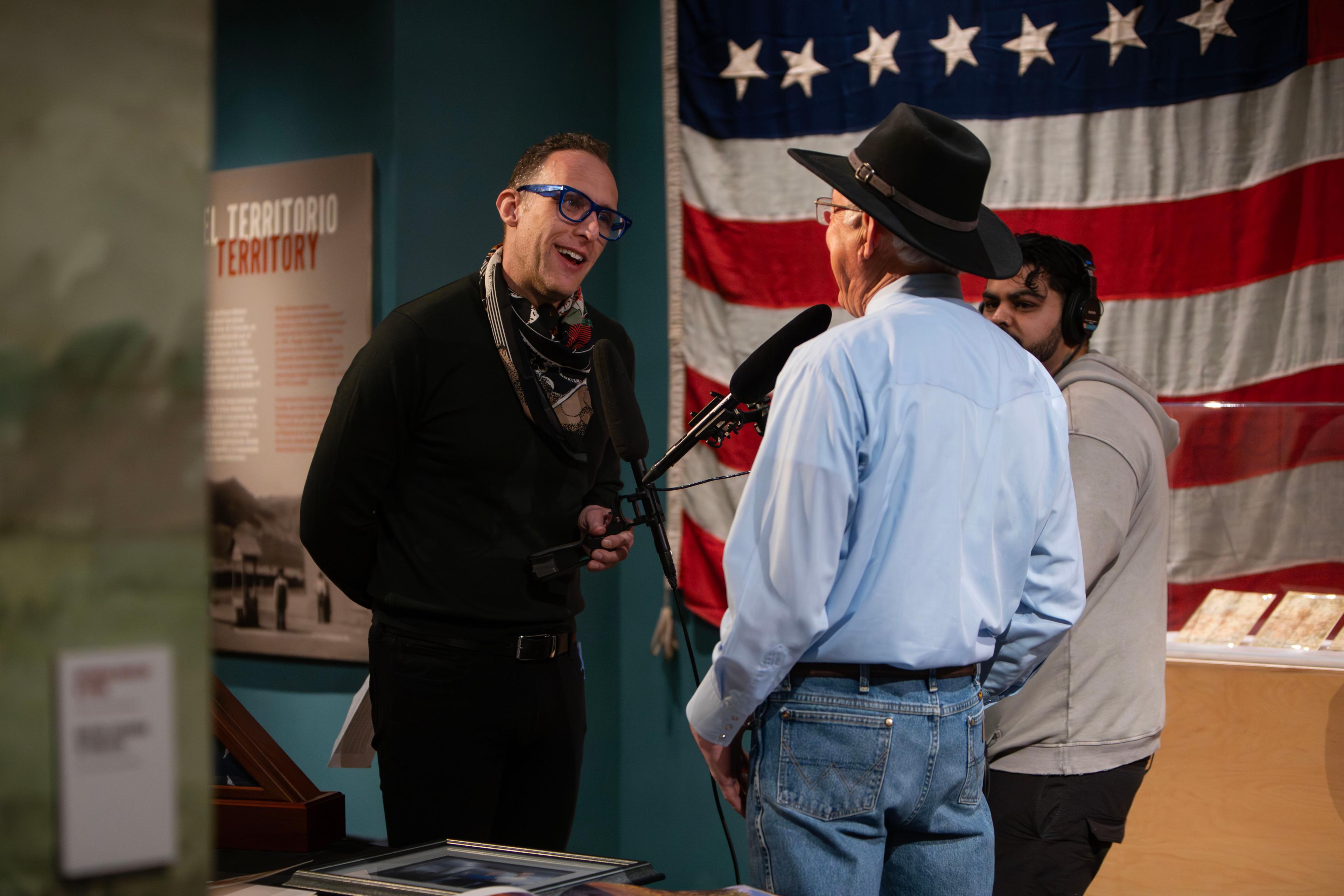
As History Colorado launches a decades-long Borderlands initiative, former U.S. Senator, Interior Secretary and Ambassador to Mexico Ken Salazar reflected on the personal history he carries alongside his public life. Speaking at the exhibit on the 177th anniversary of the signing of the Treaty of Guadalupe Hidalgo, Salazar discussed family artifacts, growing up in Southern Colorado, and why understanding borderlands history remains urgent today.
This interview has been lightly edited for length and clarity.
Ryan Warner: This is an important anniversary. Why does this date matter?
Ken Salazar: 1848, the Treaty Guadalupe was signed. All of what is now the Southwest of the United States is ceded by Mexico to the United States, and so this is the date that it was signed, the treaty between the United States and Mexico.
Warner: Many people say, ‘We didn’t cross the border, the border crossed us.’ Do those words resonate with you?
Salazar: My family has been in what is now the United States for 400 years. And so when the border was created, we’d already been here 250 years. And so the story of the borderlands really is about the Southwest, and really all of the United States and Mexico, because it’s more than just a physical or political wall. It is, in fact, two communities that have a long shared history.
Warner: There’s a quote at the entrance to the exhibit describing borderlands as ‘a vague and undetermined place.’ What does that mean to you?
Salazar: Political boundaries are just that. They are boundaries, but they don’t follow the ecology, the natural routes of the landscapes. … To recognize that history that’s been around for thousands of years in the geographic terms, in the history of Native Americans, in the history of Mexican Americans, in the history of United States settlers is really, really important because especially in these times when we are living in such a divided, divisive, angry world, it is important for people to know that history and not to erase it.
Warner: Southern Colorado feels like your origin story. How much of that place did you carry with you in your public roles?
Salazar: I’ve carried it in my heart and in my mind throughout all of my time and in all these positions. … Living that story has just been a remarkable journey that’s been full of pain, but full of promise and full of hope. And today I’m more hopeful than ever, but it’s really dependent on us being able to have an understanding of that history so that we can use it as a point of unity as opposed to a point of division.
Warner: What did it mean to serve as U.S. ambassador to Mexico with the last name Salazar?
Salazar: It was celebrated by the Mexican people. … For me it was a continuing journey of discovery from my time in the San Luis Valley, as you say, an origin story, if you will, all the way to this last chapter.
Warner: What did you learn during your time in Mexico?
Salazar: The greatness of the Mexican people and the relationship to the United States and also the horrific pain that still exists today because of the Mexican-American War, which explains much of the difficulty in solving the problems that we face in Mexico and the United States. … You’re not going to get there unless there’s an understanding of this history.
Warner: You’re donating hundreds of boxes of family papers and artifacts to History Colorado. Why was that important to you?
Salazar: Our language at home was all Spanish. … The oral history that would be handed down to us was a history of the family. And so we learned about our history really at home because we were never taught about it in our schools.
Warner: One of the artifacts on the table is a photograph of your parents at the family ranch. What does that image represent?
Salazar: It’s my mom and my dad at the ranch in Los Rincones. … My father was born in this place in 1916. It’s the same place my grandmother was born in 1884, and it’s a place where my family has been since the 1850s.
Warner: Another item is a folded American flag flown during your ambassadorship. What does it mean to you?
Salazar: This flag was flown over the nine consulates in Mexico, which are all over Mexico, the United States Embassy in Mexico City and the residence of the ambassador. … The people there said, ‘This flag is being given to you in your honor, ‘Somos familia.’ We are one family. And to me, the fact that we are one family says it all.’
Warner: You’ve said the effects of the Treaty of Guadalupe Hidalgo are still felt today. How do you see that?
Salazar: It explains exactly what’s happening today. The paralysis in Washington over the border. … What’s being built is not a relationship of understanding, but a relationship of division, which is bad for the United States and bad for Mexico and bad for the continent and bad for the world.
Warner: The Borderlands initiative runs through 2050. What do you hope people take from it?
Salazar: Nobody is better than anybody else. We’re all the same. We’re all people, and we need to recognize and celebrate everybody’s history, and that’s the most important part of this exhibit.